
Director: Wes Anderson
Stars: Mia Threapleton, Benecio del Toro, Michael Cera
Call it a failure of objectivity if you wish, but a personal approach to Wes Anderson feels like the only way to go at this point, as I must admit a taciturn relationship to the American auteur’s intensely curated filmography. Some of it works for me, some of it does not, and this decade alone has already proven out this schism. I found The French Dispatch to be among his finest efforts, lionising the traditions and ambitions of print journalism with a showman’s aplomb, whereas Asteroid City completely alienated me; a detached desert train ride to nowhere that seemed mostly to act as an elaboration of writer’s block.
The Phoenician Scheme feels like it arrives hot on its heels. Perhaps because of the litter of Roald Dahl shorts that landed on Netflix in the interim. It doesn’t seem as though we’ve lacked for Wes. Still, the build-up and release of this one has felt decidedly quick and muted, as though it were the movie equivalent of a B-sides collection. Lesser work worthy of quieter fanfare. There could be an element of truth in that; from the cluttered cast to the over-tidy frames and every-present whimsy, there’s a quality of overfamiliarity at this point. Anderson isn’t about to change up his presentation style anytime soon. But, for this viewer, there were greater charms to be found in the renewed focus on thematic mainstays and the pleasures of the film’s central trio of performances.
It’s 1950 and Zsa-zsa Korda (Benecio del Toro) is a lifelong entrepreneurial industrialist infamous for his backhanded tactics and ethical corner cutting. He’s made a great many enemies and has walled himself in from significant connections. With a rabble of nine sons (mostly adopted, it seems), he lives in an expansive mansion but belongs to no country, and spends his time fending off attacks from either this aforementioned brood or a seemingly endless litany of international assassins. He’s survived multiple plane crashes. Indeed, we first encounter him in the midst of his riotous sixth which begins with a moment of hilariously gory punctuation.
Having miraculously survived this latest attempt on his life, Korda extends an olive branch to his only daughter Liesl (Mia Threapleton), who is just weeks away from taking her vows and joining the sisterhood. Korda has another proposition for her; reclaim her position in his empire, become his heir and help him deliver his most ambitious project – the ‘Phoenician Scheme’ of the film’s name – even as his rivals attempt to thwart him with spies and stock market manipulation. With deep reservations, Liesl agrees. In tow, seemingly by happenstance, is Korda’s newly appointed tutor, Bjorn (Michael Cera). The three of them get to work. Principally this means securing the required funds for the enterprise, as Korda might not be quite as flush as appearances suggest.
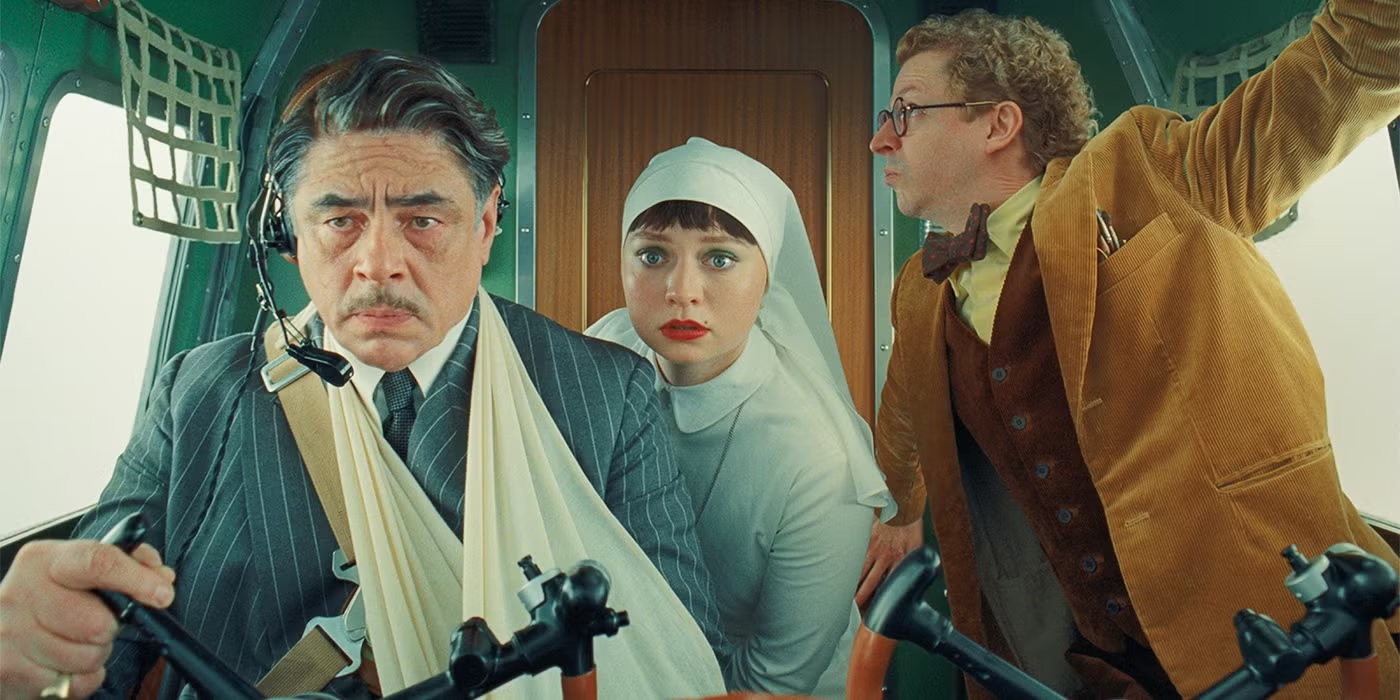
It’s another tale of an adult child dealing with the reappearance of a physically distant, now emotionally recalcitrant parent, something we’ve seen before in the likes of The Royal Tenenbaums, The Life Aquatic and The Darjeeling Limited. Fertile ground for Anderson, which seems like a pointed preoccupation at this juncture. Indeed, del Toro’s Korda feels particularly kindred to Gene Hackman’s Royal Tenenbaum, nailing a specific streak of masculine bravura that belies a chancer or fraudster at heart. An improviser trying to make it all look deliberate. Perhaps it is this connection to past glories. Perhaps it is del Toro’s winning performance. Either way, it makes The Phoenician Scheme feel comfortable and sturdy.
del Toro’s company seals the deal. I underestimated the young Threapleton who, from her physical baring in the film’s trailers, I took to be a stand-in for an otherwise-busy Leá Seydoux. But Threapleton more than makes up for the absence of any member of Anderson’s art-house stable. She’s a firebrand addition to the roster, and her work both nails the typically dry sensibilities of her director and hints at a wealth of emotional resonance beneath the surface. It’s akin to seeing someone like Florence Pugh or indeed the aforementioned Seydoux for the first time. You know, immediately, this one’s going on to bigger things. The spark between Threapleton and del Toro steers The Phoenician Scheme through its episodic fancies, while the addition of Michael Cera to Anderson’s pack of players seems so natural as to beg the question; why hasn’t this happened sooner?
There continues to be something old world – even conservative – about the things Anderson finds romantic and charming, like the attitudes of the imperialist or colonialist. And it’s almost ballsy of him to frame this latest feature around a 1%er looking for some kind of eleventh hour salvation, either fiscal, familial or spiritual. As ‘billionaire’ becomes (*cough* rightly *cough*) a dirty word, this sympathy for the devil feels potentially as antiquated as Korda himself; something Anderson feels compelled to look back upon with a curious pang of nostalgia. Ultimately, the lessons learned along the way present an incredibly optimistic worldview from Anderson. That, for the world’s winners, losing could be the only viable path to finally winning for real.
It’s a worthy enough sentiment, and it certainly helps bolster what, quite often, feels like more of the same from this director. Most of the big-name actors present have what amount to walk-on line reads, as detached and diminished as has become custom. Little more than clutter and distraction. Cinematography and production design is as exacting and airless as one ought to expect by now.
It seems to me, then, that the key ingredient to getting a Wes Anderson picture to work is that kernel of emotional resonance between main characters that cuts through all the suffocating foibles that have come to typify his work. It wasn’t there in Asteroid City for me, and thus the work came to feel meaningless and stifling. And while the way it manifests in The Phoenician Scheme is just as borrowed from Anderson’s playbook as every other aspect, it’s existence means that, even if the movie runs out of steam by the time Benedict Cumberbatch’s ridiculous-looking Uncle Nubar enters the picture, this is a clear step in the right direction for a filmmaker I’d come close to writing off completely.

 The Lost Highway Hotel