

Director: Miguel Gomes
Stars: Gonçalo Waddington, Crista Alfaiate, Cláudio da Silva
The fickle appetites and follies of waning colonialist Britain are playfully lambasted in Miguel Gomes’ welcome return to our screens. 2021’s The Tsugua Diaries (co-directed with Maureen Fazendeiro) passed almost completely under the radar, meaning that Grand Tour is Gomes’ first broadly available release in the UK since 2015’s Arabian Nights trilogy (a sprawling anthology that was as joyful as it was frequently impenetrable). Grand Tour continues Gomes’ globalist endeavours, and where 2012’s celebrated remake of Murnau’s Tabu took us on a jaunt from Europe to Africa, here the Portuguese cineaste criss-crosses East Asia in what seems to be his preferred time period, the 1910s.
Edward (Gonçalo Waddington) is a British expat working in administration in Burma when he learns that his fiancée of seven years, Molly (Crista Alfaiate), is soon to arrive to meet him. Evidently dreading the reunion and with no intention of marrying her, Edward absconds across the continent, fleeing her steady stream of telegrams. It’s an odyssey that takes him through Thailand, Vietnam and the Philippines, before deportation from Japan leads him to the mountainous regions of China, where jungles threaten to consume him. But Edward’s cowardice knows no bounds, and he’ll keep moving so long as he suspects Molly is on his tail.
Molly isn’t even seen until the film’s midway switch. Just as Edward’s gallivanting slows and threatens to stagnate, Grand Tour changes hands and the second half replays the timeline from her perspective. But this is far from the only blurring of chronology presented. Taking a leaf from the likes of Chris Marker, Gomes blithely alternates between his monochrome presentation of the 1910s Orient and modern day footage of these cities, using it in a quasi-Mondo style to patchwork over budgetary constraints or boundaries, in the process conjuring a fanciful travelogue in which history is ever-present.
The sometimes arbitrary collaging of time is up to us to decode and decipher. In Edward’s half of the film we often return to footage of the human powered Ferris wheels of Myanmar. Might we imagine these are Edward’s dreams, elucidating his sensation of forever travelling without moving? The incessant pursuit aspect of the film coupled with these dizzying temporal lurches connect Grand Tour – spiritually at least – to Lisandro Alonso’s slow masterwork Jauja.
This isn’t the only cinematic connection present. Far more prominent is Gomes’ use of Strauss’ Blue Danube Waltz, which can’t help but conjure Kubrick and 2001: A Space Odyssey – another film to use the music in conjecture with bold cuts across time. Gomes recontextualises those associations with spinning spacecraft by setting the music against Vietnamese motorcyclists traversing a roundabout (in a way, the same sort of circular motion, also echoing Edward’s feeble efforts).
Gomes undeniably has a way with musical selection, and here flexes with several interludes that provoke emotion. One of the modern excerpts sees a stout Filipino man singing “My Way” in karaoke. The man is overcome with his own emotion, and while we can’t know what circumstances have moved him, his private catharsis is strangely touching. Elsewhere, a sombre rendition of the “Eton Boating Song” swells powerfully against scenes of Asian riverboating, evoking wistful romanticism in the dying embers of the British Empire.
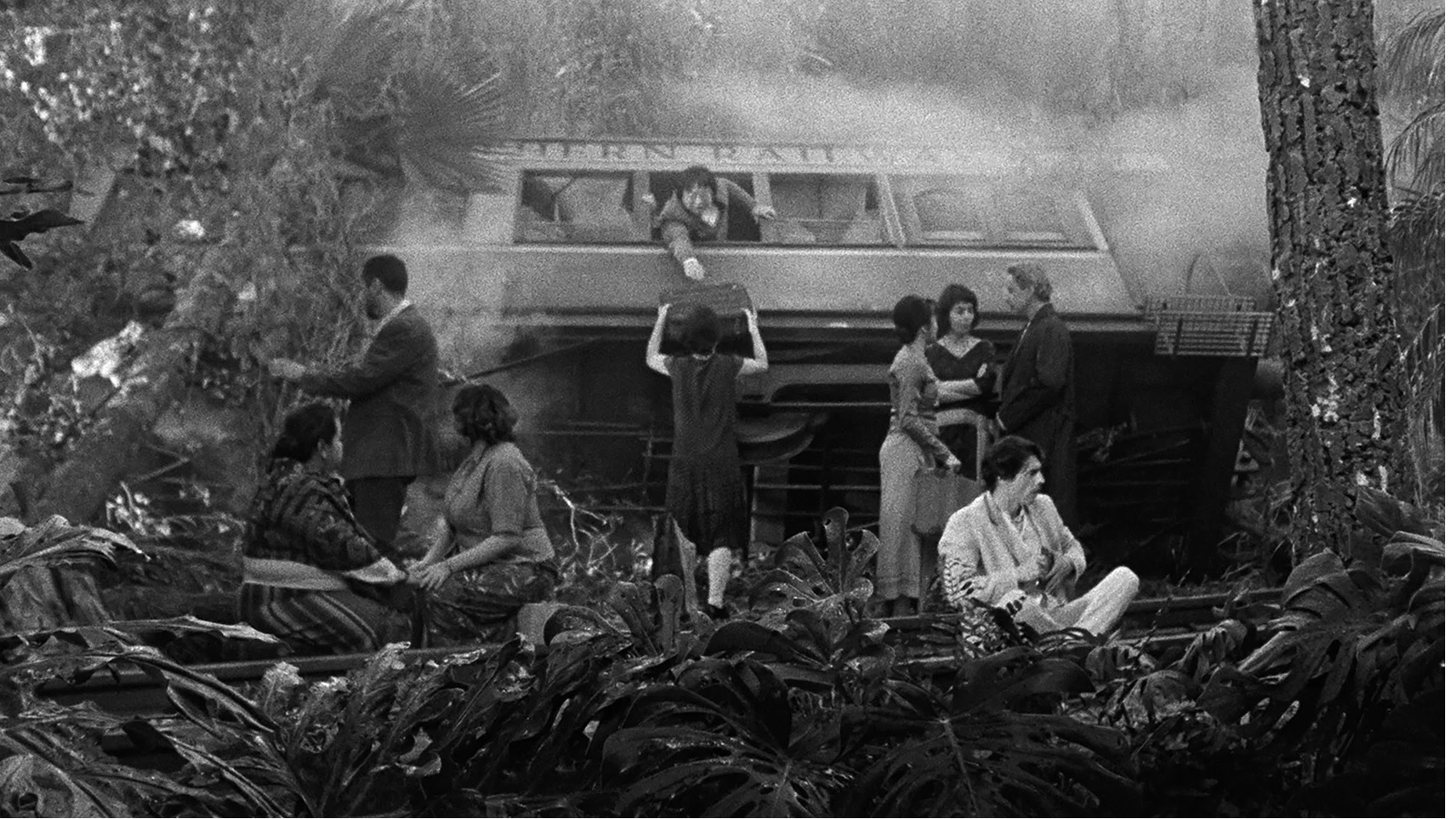
Those end times are all over Grand Tour, appearing with both melancholy and the wry detachment and amusement of our modern sense of hindsight. In Molly’s half of the story she encounters a woman monikered Lady Dragon (Joana Bárcia) – a bourgeoisie stuck at the site of a train derailment – effluviently naming her favourite flowers as natives hammer practically at the tracks in the foreground. A tableaux of Western dalliance. It’s there also in the hubris of a British colonialist who declares that he feels at home anywhere. Is Gomes unaccountable though? Isn’t he following in the same footsteps? Grand Tour can play like a rather basic travelogue, distracted by exoticism (the long sections preoccupied with puppetry are particularly listless). Fortunately, for the most part, it plays like the kind of film Wes Anderson thinks he’s making.
And this is thanks to the beguiling sense of style that permeates. The arresting sight of the aforementioned derailed train carriage (first encountered in Edward’s story) is a more evocative surprise than the destructive action could have been, and Gomes understands the beauty of smoke in the same way David Lynch did. Texture is an abundant pleasure in the grainy cinematography. The gleaming surface of a river, elsewhere, has the slick oiliness of metallic paint.
The wilfulness of the heart is the folly most romanticised. Molly – prone to deeply unserious sputtering – seems to find Edward’s evasiveness cute or playful. Possibly a kind of foreplay. Her blindness is mirrored in the affections directed at her by American industrialist Timothy Sánders (Cláudio da Silva), who turns Grand Tour into a minor farce and three-way cat’n’mouse act, pursuing Molly as she pursues Edward. In the process all three of them become evocative of the imperialist attitude; always wanting what can’t quite be captured. Edward’s fear of Molly – of his responsibility – is outright comical. The ‘STOP’s on her telegrams come to read like directives or even threats.
The playfulness of Grand Tour is its sense of grace, evident early on when a cellphone is anachronistically dropped into frame, jolting us out of the illusion, out of memory. What is memory, it asks, and can cinematic conventions be trusted? This prankster’s urge to upset is there right to the end, when Miguel breaks the fourth wall most boldly. As Molly lies dying she is revived by a rigging crew’s blinding lights. A touch of divine intervention casting the filmmaker as a deity? The lord of his dominion? It’s quite a brassy exit strategy, but the exuberance of Grand Tour overall means that Gomes basically gets away with it.

 The Lost Highway Hotel