
Year: 2002
Director: Marina de Van
Stars: Marina de Van, Laurent Lucas, Léa Drucker
As my voracious appetite for new cinema experiences perpetuates, there are moments of reflection – especially when it comes to boundary-breaking films – that sit like landmark discoveries in my own personal journey. Among the most memorable of these, by default, are the movies that not only compelled me, but wholly staggered and consumed me. The ones that had me holding my breath, both with shock and admiration. I’ve written previously about my reckoning with The Texas Chain Saw Massacre (1974), a film I now consider firmly among the greatest American movies ever made. In terms of sheer visceral response on first flush, few challenge it. But one that does, unquestionably, is Marina de Van’s In My Skin, which I first encountered a couple of years ago.
Widely considered part of the turn-of-the-century insurgence of New French Extreme cinema – appearing in a continuum with the likes of Baise-moi (2000), Trouble Every Day (2001), Irreversible (2002) and others – In My Skin stands somewhat apart from its edgelordish sisters in a large part thanks to it’s apparent subjective autofiction. Not only written and directed by Marina de Van but also starring her as it’s central figure Esther, In My Skin invites an assumed autobiographical aspect. de Van has been contradictory on this subject over the years, and so its prudent to maintain some level of cautious suspicion. Yet she is completely giving in the film, which feels like a literal and metaphorical reckoning with the self.
Esther is a young professional working for a marketing firm, living in Paris but alienated and numbed by the world around her. Literal numbing. While at a networking party at a large house, Esther stumbles in the grounds and severely lacerates her right leg, but she doesn’t feel it. She is surprised to discover that the source of bleeding in a bathroom, later that evening, is her own calf. Even on leaving the party, she suggests getting further drinks elsewhere before going to get medical attention. The male physician (Adrien de Van – her brother) chides Esther, but also evaluates the wound primarily as an aesthetic one, tarnishing some assessment of the feminine ideal.
Hereafter Esther becomes completely fixated with the wound, hampering its healing by picking at it, before finding a sense of grace and relief by reopening it at work with a sharp piece of metal. Esther hides from her co-workers when she does this in the office, making the act private and illicit thanks to the element of risk involved. She could quite easily be discovered. But In My Skin isn’t especially interested in thrills. It’s a more complex study of compulsion, one that is evidently about self-harm but as knotty and intricate as that subject demands. Especially as Esther’s compulsions evolve from cutting and picking, to eating her own flesh.
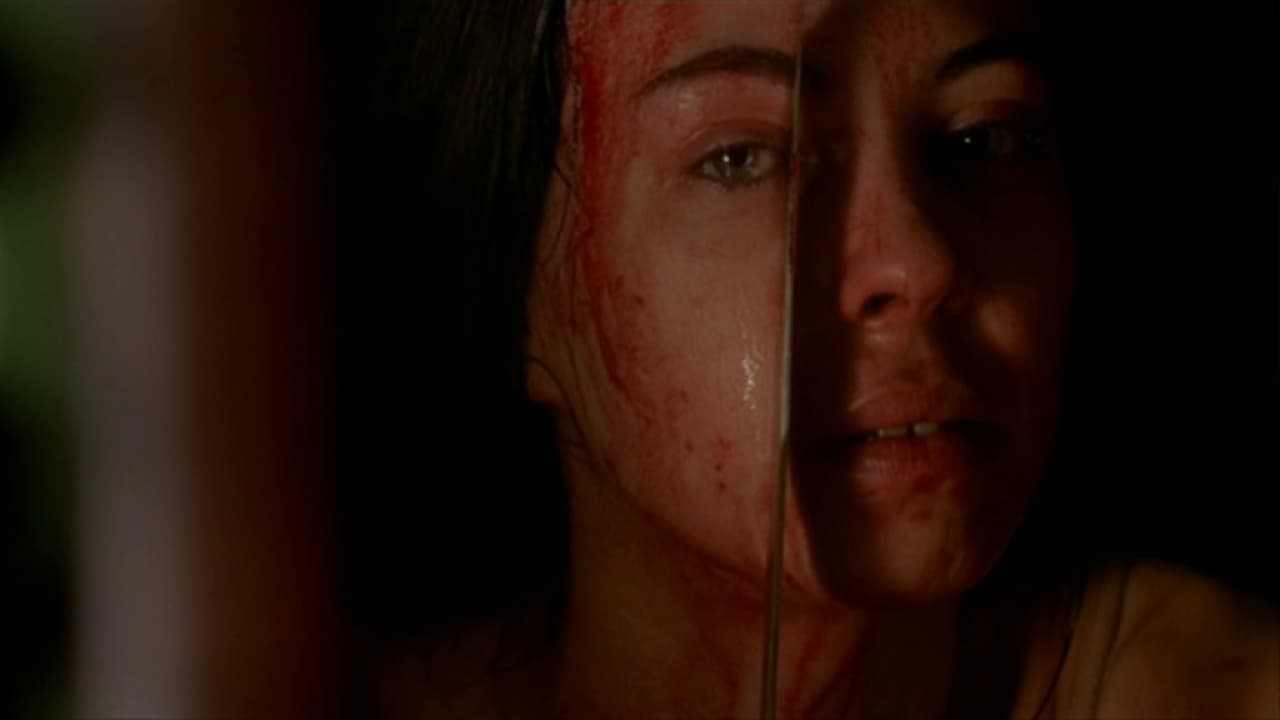
The film’s opening titles feature a series of almost bland images of urban living in split screen, with a negative image appearing opposite an original. Sometimes these match-up, sometimes they don’t. So from the beginning there’s a sense of bifurcation and severing that is furthered, and of normality being disrupted. It reflects pertinently on the dichotomy of Esther, who presents outwardly as buoyant, successful, and happy at home with her boyfriend Vincent (Laurent Lucas), but whom we are also allowed access to at her most private, as she goes down this rabbit-hole of self-mutilation that has multiple readings. Shards inside shards.
On one level the intense self-harm – and eventual self-consumption – depicted belies a malaise and desperation with the modern world; an attempt to regain some sense of feeling in an environment of slick, glossy dissatisfaction. That Esther works in advertising – selling distorted versions of the world – is surely no coincidence. On another Esther’s processes and ceremonies are deeply revelatory; she is discovering herself in a manner so radically disconnected from the world around her as to be impossibly precious. It chimes with the cool depiction of obsession and fetishism scrutinised by David Cronenberg in his adaptation of JG Ballard’s Crash. Unsurprisingly, In My Skin is often labelled ‘body horror’, but the moniker that more poetically fits de Van’s film is cinéma du corps – the cinema of the body.
Viewing the film this way it presents as much as an existential crisis as a mental health one. Each of us experiences the world from within the prison of our own bodies – vessels we can never truly see in their entirety. There’s great comfort in notions of civilisation and community. Being part of the group and having shared experiences and frames of reference. But on a personal level these are never fully complete. There is always, deep down, the suspicion that we are intrinsically alone within ourselves and that we are ultimately unknowable to others. In My Skin depicts a person so disconnected that she is unknown to herself, and charts an inward (re)discovery.
In My Skin has many standout scenes, but high among them is a corporate dinner that Esther attends shortly after receiving a promotion. While dull pleasantries and thematically relevant chitchat about communication breakdowns crisscross the table, Esther has a kind of hallucination that her left hand has become separated from her body, lying limply on the table beside her plate. While she manages to pull herself back together, the emotional rupture continues. She is visibly distraught and shaken, but this goes seemingly unnoticed by her comrades (though she is later reprimanded for being withdrawn). Out of sight, she stabs at her arm with her steak knife. de Van intercuts this with other restaurant patrons cutting into tender, bloody meat on their plates, both preempting Esther’s escalation to consuming her skin, but also making a visual metaphor for how society packages and consumes women – through objectification – en masse. Is Ether’s self-consumption, therefore, an act of reclamation? Of getting the jump on this act of commodification before the world at large can?
Like all scenes in the movie, it is hypnotically controlled. For such a small production, In My Skin has a remarkably taut veneer, aided in no small way by cinematographer Pierre Barougier whose repertoire before and since has been in advertising and, wryly, intensely connected with how food is presented by corporations.
Having made a mess of her arm, Esther excuses herself to find another quasi-private space to explore her newfound wounds with intimate reverence. As previously, there is something erotic about her breathing, conveying a kind of tremulous arousal. She is almost immediately forced to hide when a waitress appears. We see Esther peek out from behind some crates. Her life is in the shadows now.
The grotesquery of In My Skin makes it an incredibly tough watch, but if we indulge ourselves like Esther and divorce from the disgust, aren’t we witnessing a perverse expression of self-love? It is, of course, unsustainable, unhealthy and vehemently unsafe, and speaks to a profound psychological distortion. But isn’t there something heartbreaking about the unsustainability of Esther’s bliss? She’s found the most perfect thing to fill this void in herself – herself – but continued abuse of her body may well kill her.
Sound is excruciatingly key in In My Skin, and links the film spiritually to another extreme film of it’s era; Takeshi Miike’s equally intimidating Audition. Earlier on in the film, when Esther tears at her scabs, the camera doesn’t focus gratuitously on the wound, but on Esther’s face and her emotional response to her picking. The sound effects are nauseating, prompting us to imagine what we’re not seeing, as Miike does in the culmination of Audition with the long metal needles being inserted into Aoyama’s eyes. However, like Miike, de Van gets graphic, showing us the results of Esther’s violence in a grisly exhale. Still, the aural work prior to this – and throughout the picture – is profoundly effective.
Come the end of the picture, Esther has submitted to her downward(?) spiral, but again it is presented in an almost positive and euphoric light. Self-destruction as self-empowerment. Understanding this involves having some understanding of the motivations behind self-harm, rooted in privacy, control and healing. Having explored the film at a cursory level with some critical distance (and each aspect of the above could be a long deep-dive), it becomes time to approach it more personally. Why is something as uncomfortable as In My Skin something I can love?
I’m someone who has struggled with my mental health for many years. And while never a cutter, I feel some degree of understanding about why such a compulsion would overcome someone. Having something that’s yours. Something you made. Something that you can then care for and see heal on your own terms can provide solace when there are other overwhelming problems in one’s life that cannot be corrected so swiftly. This is where control comes in, and the dopamine of having that intimate sense of self-care – no matter how contradictory that may sound. Pain can also make one feel alive when the rest of the world seems so aloof to our suffering. Particularly if one’s struggles are mental as opposed to physical, it can be an outlet for a pain that otherwise has no focal point on the body. At it’s most crude… a release valve.
These concepts are conveyed through In My Skin without dialogue. They’re conveyed through action and through the committed work of de Van. It is an act of generosity. As devastating as watching In My Skin is for its visceral elements (the make-up effects are amazing), it’s equally an emotional gauntlet. I had to psyche myself up to putting on Severin’s gorgeous new 4K remaster. But in that devastation there’s also solace. Someone else feels these things. Someone else has these pains and understands them. And is able to convey that fearlessly. There’s something undeniably resonant and touching in that. Through self-expression, de Van extends to us an outstretched arm.
I understand that she wanted to play the part herself against the desires of some producers. Apart from budgetary practicalities of starring in your own film, might there be some level of safeguarding on de Van’s part – committing to this incredibly demanding role herself and saving another from having to go through it? In the years since I first saw the film, I’ve continually had this feeling that de Van played Esther in part out of territorialism – if this is her story – and in part out of altruism. If someone’s going to go through hell for her art, why shirk that responsibility onto another?
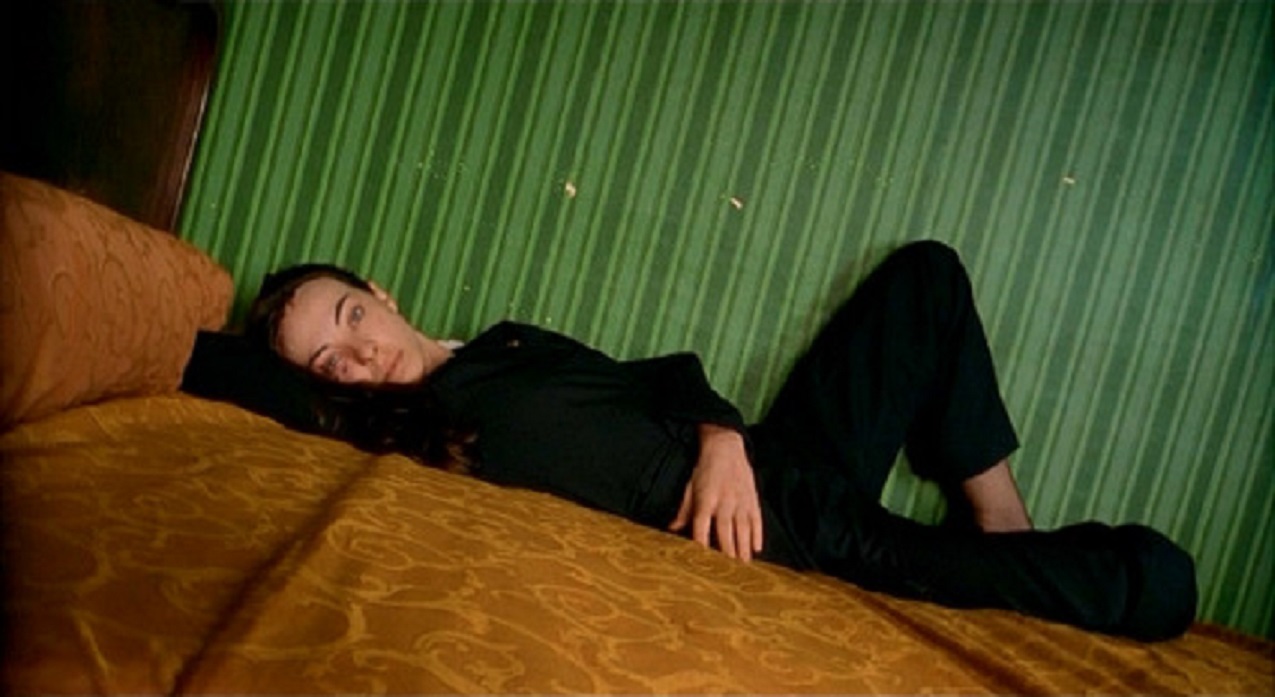
Come the end of the film, Esther has withdrawn to one of several hotel rooms (furthering an idea that she’s having a kind of affair with herself). In an absurd moment – both comic and deeply, deeply sad – she dresses again for work, bloodied and scarred from her efforts. She even leaves the room, but this feels functional, robotic, disconnected from the person she has become. In keeping, the scene continues with her in the room. She lies motionless, expressionless, staring back at us as we cycle through a series of dissolves until we see her complete. The sense given, then, is that she can’t go home again. It is the film’s final bifurcation, one that leaves us to decide where the real Esther resides. It’s cold and challenging, right up to and beyond the second de Van cuts to black and leaves us staring, decimated, into our own dark reflection.
 The Lost Highway Hotel
2 thoughts on “Why I Love… #182: In My Skin”