
Year: 2011
Director: Rena Riffel
Stars: Rena Riffel, Shelley Michelle, Greg Travis
You’d be forgiven for forgetting Rena Riffel’s character Penny Slot from Paul Verhoeven’s notorious 1995 romp Showgirls. She’s frequently there though, in the background and peripheries of the narrative, snatching the affections of Glenn Plummer’s Jimmy when Nomi (Elizabeth Berkeley) proves too tempestuous and taciturn. She’s somewhere between a supporting character and a featured extra. One might also conceive that Riffel’s brief cameo in David Lynch’s Mulholland Drive as sex worker Laney is a version of Penny beamed in from a dream dimension, down on her luck, turning tricks on the harsh LA boulevards. She appears there even more fleetingly; a glimmer of something happening outside the borders of the frame. A tantalising loose thread in the moebius-strip narrative. But, once noticed, there’s a quality about Riffel’s characters that lingers like an unfinished thought.
On release Showgirls was met with rampant hostility, derided in the press, the butt of every joke, the recipient of every Razzie. But in the intervening years the movie proved itself, took on a life of its own. It found itself reclaimed particularly by the queer community, and has been slowly granted a deserved reappraisal (I’d steer you toward Jeffrey McHale’s superlative essay film You Don’t Nomi for a spirited retrospective). It – and Penny – evidently lived on for Riffel in a more nagging, defining manner, leading to this sprawling, personal revisit; a self-penned sequel directed, edited and co-produced by Riffel herself. The kind of all-or-nothing micro-budget passion project that, in the wake of the ever-memeified Tommy Wiseau, sets red flags aflutter.
On the evidence of Showgirls 2: Penny’s From Heaven, Riffel’s brief time in the orbit of David Lynch was life-changing (he’s thanked in the end credits here along with Verohoeven). Made on a pittance in the region of $30,000 and running to a dazzling 145 minutes, Showgirls 2 is a lo-fi epic. It’s little seen. Sorely under-distributed. But it’s crying out for a remaster and re-release from a boutique label because it’s a strange kind of masterpiece, one that feels more than a little bit in the thrall of the fascinating digital experiments Lynch was conducting throughout the ’00s. Indeed, Showgirls 2 often feels more spiritually connected to INLAND EMPIRE than it does Showgirls. Much as I love Verhoeven’s movie, that’s a compliment that places Riffel’s effort on a whole other plain.
Riffel takes Penny out of Vegas, hitchhiking to Los Angeles with dreams of making it there in a show called Stardancer that sounds, itself, like a tell-all tale of the making of the first movie. She gets screwed over by her ride (Dewey Webber, reprising), becomes witness to a grisly murder and inadvertently causes one herself. Disguising herself, she runs in heels down Mulholland Drive, furthering an uncanny sense of a character who has crossed into a whole other cinematic universe. She even acquires a pseudonym for her Hollywood self; Helga. Penny/Helga is endearingly naive. A hyper-sexualised variant on Betty from Mulholland Drive. There’s a sense that this is down to saturation in the objectifying environs of Vegas. She’s conditioned that way. Hollywood, it transpires, only perpetuates an equivalently desperate milieu.
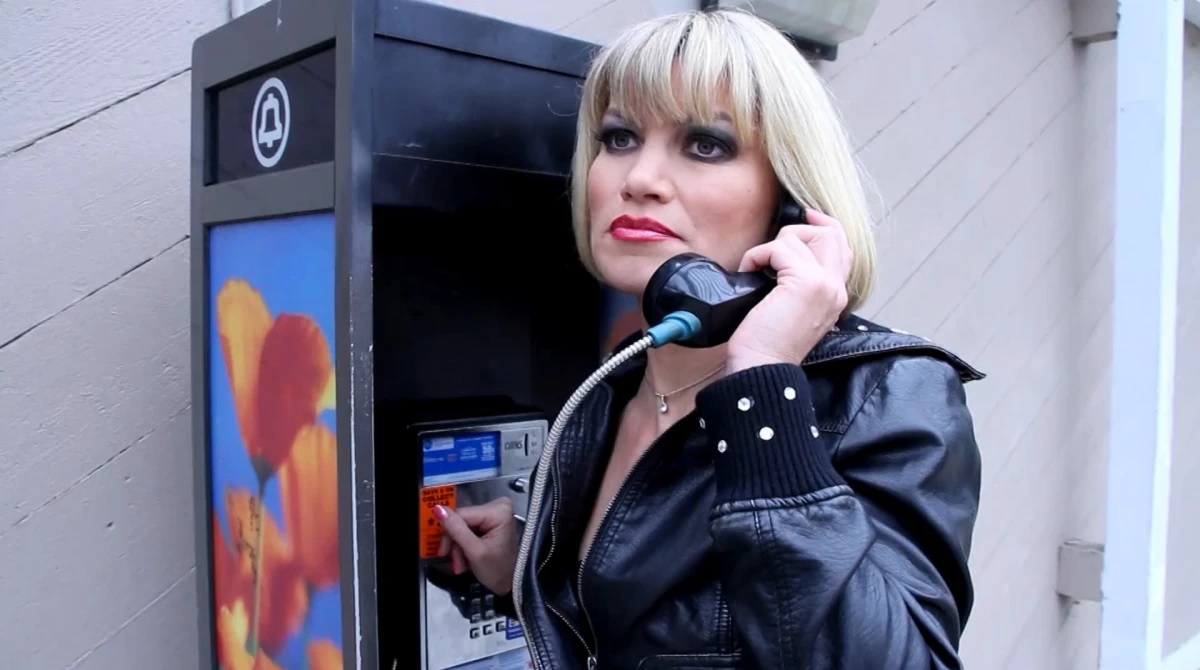
In spite of distractingly poor production circumstances (Penny’s hitchhiking ride is clearly going nowhere), Riffel’s film redeems itself through its unexpected qualities. Filmed on a mix of DV, 8 and 35mm, it’s easy to kneejerk reject what Riffel’s offering. But, as with INLAND EMPIRE, that harshness and intimacy engenders its own raw textural immediacy, delivering a sense of danger and intensity it might not otherwise have acquired.
Dreamy buildings populated with strange characters further a sense that we’re tumbling down a seedy Hollywood version of Alice in Wonderland. Ambitious violinist Godhardt (Peter Stickles) leads Penny/Helga to the ‘Rainbow Room’, where the host is a literal devil and her chaperone’s expositional spiel is a diatribe on secret societies. So cluttered is Showgirls 2 with asides, journeys, aliases and costume changes that it carries INLAND EMPIRE‘s sense of one personality in constant fragmentation. There’s enough experimentation in the camerawork and lighting to suggest the intent to deliver something beyond the merely functional (which is often what’s offered on budgets like this). The film’s artistic ambitions manifest here most commonly.
Riffel’s writing is prone to peppering dialogue with clichés, but also turns of phrase that surprise, offend and charm, affording Showgirls 2 bags of blunt, quotable material, seemingly in the thrall of John Waters (nothing wrong with that!). Impassioned line readings (and here we are in the territory of Tommy Wiseau) successfully deliver the sense of camp that’ll seduce those watching for irony points. See also tonally ‘off’ pillow fights, phallic hotdog chomping, an exceedingly unsexy masked foursome and Riffel’s abundant nudity. On this last point, given it’s Riffel who has put herself in this position, there’s a perhaps surprising quality of self-empowerment. Riffel is proud of her figure and her dance moves. Showgirls 2 is less an effort in exploitation as it is an expression of pride and self-love. A seedy, extremist talent show.
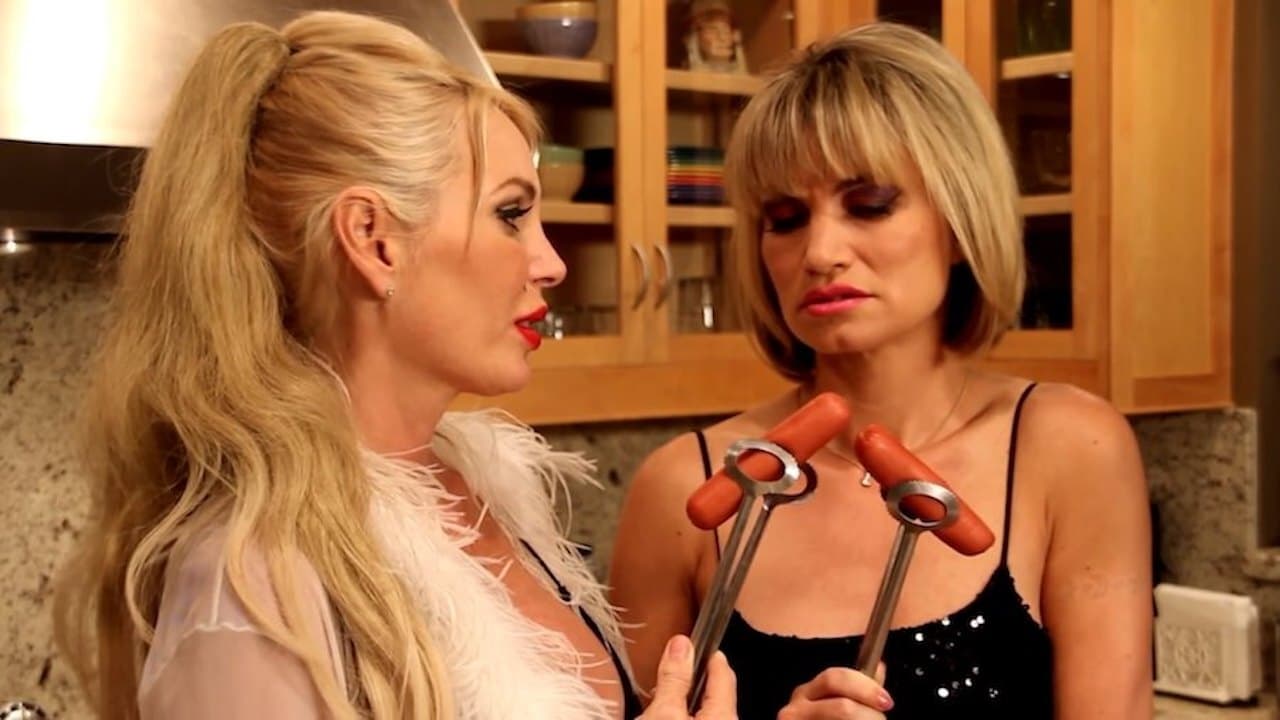
The middle of the film sees Stardancer performed frantically by an amateur dramatics group in one of Hollywood’s hidden theatre spaces, complete with the infamous slip on faux-diamonds. But the story is spliced with LA strangeness and the seeded propensity for conspiracies and secret societies. It even looks like the set from Lynch’s Rabbits. It also turns out to be televised with Penny watching, casting her, briefly, as INLAND EMPIRE‘s Lost Girl, shut out of a world she once belonged to. Penny finds herself inexorably in competition with Stardancer‘s star, prima ballerina Katya (Shelley Michelle).
The dynamic of star and protege that manifests between Katya and Penny/Helga connects Showgirls 2 further to Verhoeven’s film, mirroring the relationship between Nomi and Cristal. There’s a more positive sisterhood between them, however, as though Riffel is trying to correct and improve on the first film’s dynamics. Seeking a more optimistic, feminist outcome. Reaching to break the cycle. The swimming pool lesbian sex scene that (inevitably) ensues plays knowing homage to the one from Showgirls (so much thrashing…), but it also feels like a (madly misguided) attempt to connect us back to Lynch and Mulholland Drive, as though Penny/Helga and Katya might be Betty/Diane and Rita. Maybe that’s a reach, though… (“Here’s bubbles!”).
Still, the catty interplay between Riffel and Michelle is immensely enjoyable, and easily the most giving dynamic. Both are so extra. Michelle’s performance of Katya’s mirror monologue is as delicious as it is grotesque. Lathering herself in face cream, is this another Lynchian ode, harking back this time to Diane Ladd in Wild at Heart?
It does run long, and once we push on to San Francisco around the 2-hour mark it feels as though we’ve run past and left Riffel’s intensely horrific Wonderland. But the sprawl is part of the thing. You have to set aside time for Showgirls 2. Take it in as an epic. It requests a certain mentality. A level of indulgence akin to its own.
With terrible sound and questionable editing (I actually love some of that rule-breaking), it would be easy to dismiss Showgirls 2 as a harsh and lurid failure, but there’s undeniably something interesting going on amid its try-hard, appealing vulgarity. Riffel understands that the outré moments are required to sate fans of the first movie’s cult appeal, but there’s a clear – even over-earnest – attempt to combine that with something more ambitious and artistic on the toxic complexities of show business, even if the full vision of what that is feels ill-defined and openly borrowed. Through imitation, Riffel is trying to communicate something all of her own.
It may have the aesthetic appearance of a 21st century Jim Wynorski joint, but Showgirls 2 is more of an attack or rebuke of that exploitative culture on the fringes of the Hollywood mainstream, and an attempt to reclaim the no-budget arena by those whose dreams have almost been crushed. The results are funny, authentic, scabrous, satirical and… kinda great. Showgirls 2 feels like Riffel fighting back and doing it for herself. There’s something immensely giving in that. And afterward? Penny Slot is unforgettable. As iconic as Nomi Malone.
 The Lost Highway Hotel