

Director: RaMell Ross
Stars: Brandon Wilson, Ethan Herisse, Aunjanue Ellis-Taylor
The fourth wall protects us all. From behind it, invisible out in the audience, we can observe, we can judge, we can make secret our hopes, desires, fears and wishes, and the story can go on without us feeling seen. Fourth wall breaks are most often utilised by comedies. A moment of irony. A cheeky wink and then the action resumes. Or they can be used to freeze us in our tracks with a dramatic piercing glare. Like in Satyajit Ray’s Charulata. Or Pier Paolo Pasolini’s Oedipus Rex. But still, order quickly returns. We’re allowed to be hidden again. Safe in the dark.
But being seen is of vital importance in RaMell Ross’ Nickel Boys, his first narrative feature and first film since heady documentary tone poem Hale County This Morning, This Evening. Here he takes the radical-feeling approach of placing us in the first person perspective. That is, from his protagonists’ point of view. This isn’t unheard of in film or television. ’40s noirs like Lady in the Lake or Dark Passage used POV for long stretches, while British sitcom Peep Show made it the entire conceit. But it’s a technique used sparsely enough to make Ross’ effort feel incredibly bold, especially when mounted on a cinema screen in all that dark, and especially given his use of it to communicate a specific lived Black experience.
Based on the Pulitzer Prize-winning novel The Nickel Boys by Colson Whitehead, the story takes place in the American south of the early ’60s. Young Tallahassee boy Elwood (Ethan Cole Sharp) seems destined for a positive future, that is until he gets caught hitchhiking in a stolen car and is convicted as an accomplice. Being under age, he is sent to a reform school, the Nickel Academy, where he learns quickly that he’s now a long way from the world, and powerless to stop the corrupt and stifling system from trying to smother him.
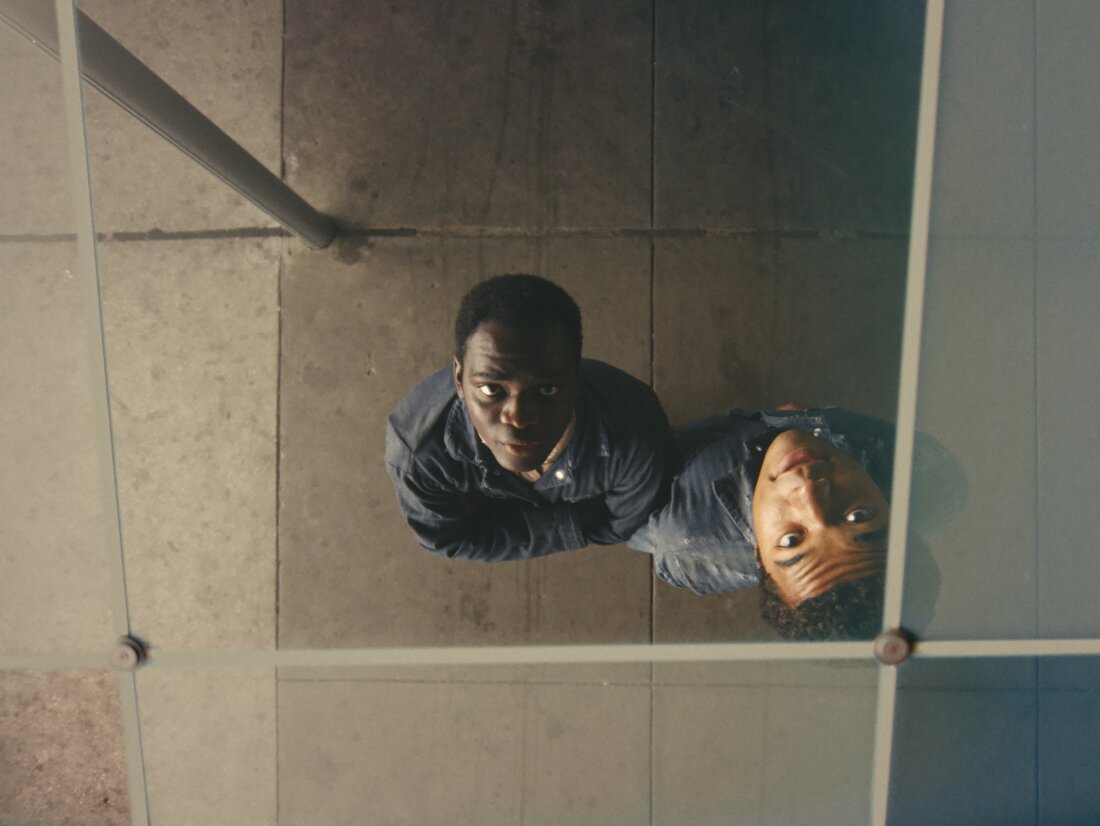
Growing up, growing older, our Elwood (now Ethan Herisse) befriends Turner (Brandon Wilson), and the view-point of the film is batted between them. Thanks to Ross’ exclusivity with his chosen perspective, the boys come to feel intrinsically connected to us in the audience. With them we’re invited to cross a sacred cinematic boundary. We’re where the cameras aren’t supposed to go.
That sense of transgression is a marvel to behold in the hands of cinematographer Jomo Fray. There are shots here that simply take one’s breath away, that feel like new ways of looking. I have too many favourites. One that stirs particularly takes place early on, aboard a school bus, when a young girl appears beneath Elwood’s seat. We crane down to her… and then follow as she crawls away. It feels like cinema unbound from learned – and hitherto stifling – conventions.
Through the eyes of these boys, Ross is able to depict societal bias and taboos often to do with looking, evoking the awful feel of second-class citizenship. Eyes up or eyes down. Nickel Boys conveys through angles the implications of a Black man’s bearing at a certain time and place. The weight of being seen and being blocked from being seen by societal norms. The ramifications of eye contact, be it intimate or accusatory.
The Nickel Academy was a real place where casually concealed atrocities occurred. It is, for Ross’ purposes, a fulcrum of the American Corrections Industry and its stealth replacement/continuation of the tenets of slavery. Martin Luther King’s ascension is played throughout as a counterpoint to Elwood’s story. King is rendered practically messianic in Elwood’s eyes, to the extent that he is jump-scared by a life-sized cardboard cut-out of the man. The promise of the civil rights movement in contrast to the shrouded misdeeds of The Nickel Academy serves to make the dichotomy and hypocrisy in the US all too clear.
This is furthered by flanking Elwood and Turner’s experiences with the progression of the space race through the decade. Mundane – yet momentous – problems at home have been eclipsed by our escape to the heavens.
If this all makes Nickel Boys sound gruelling, it’s worth adding that it manages to feel – through the cadence and drift of the camera – light as air. We feel consistently just off the ground. The most obvious cinematic touchstone that carries water might be Terrence Malick’s late, lilting period. But you could also cite Charles Burnett. Or Moss’ contemporary Raven Jackson, whose All Dirt Roads Taste Like Salt evokes a similar sense of lift and of memory, and has so far been criminally neglected by UK distributors (seriously, someone get Jackson’s movie onto our screens).
In occasional jumps into the future, Ross breaks (or more accurately bends) his first-person rules. With a camera mounted so that we see from behind Elwood’s head (now Daveed Diggs), Ross shows us the obsessive remnants of trauma, and Elwood’s continuing need to be seen, as he surfs the internet for news of further bodies unearthed from the grounds of Nickel. This move to behind the man – outside of those eyes – conveys with it a sense of detachment. Of distance from those experiences. Or arguably reshapes them as pure memory. An inner and unreliable world, yet a profoundly personal and aching one.
140 minutes fly by. And while it may seem contradictory to say, any sense of narrative meandering in the moment shifts in perspective once you’re back outside the cinema. Touched down on terra firma, Nickel Boys lands as monumental. Coming from a major studio (MGM/Amazon), this is a bravura artistic statement, astonishing to see afforded space in our multiplexes.
More of this gumption, please.

 The Lost Highway Hotel
2 thoughts on “Review: Nickel Boys”