

Director: Luca Guadagnino
Stars: Daniel Craig, Drew Starkey, Andra Ursuta
Mexico City of the 1950s. Homosexual American expats roam in cliques or prowl as discombobulated loaners. All are adrift in an outward exile that can’t help but express an inner one. Their country doesn’t want them, won’t tolerate them, so they’re here, setting up their own haven for the damned. We’re in William S. Burroughs territory. A humid, dangerous place that few cinematic auteurs have dared to cross. Luca Guadagnino’s Queer is the most overt or notable attempt since David Cronenberg attempted Naked Lunch in 1991. Like that movie it finds the source text too much at times and turns to the man himself – to Burroughs – to extrapolate some sense of shape or persistent psychology. With Burroughs, it seems, adapting the work means also adapting the man.
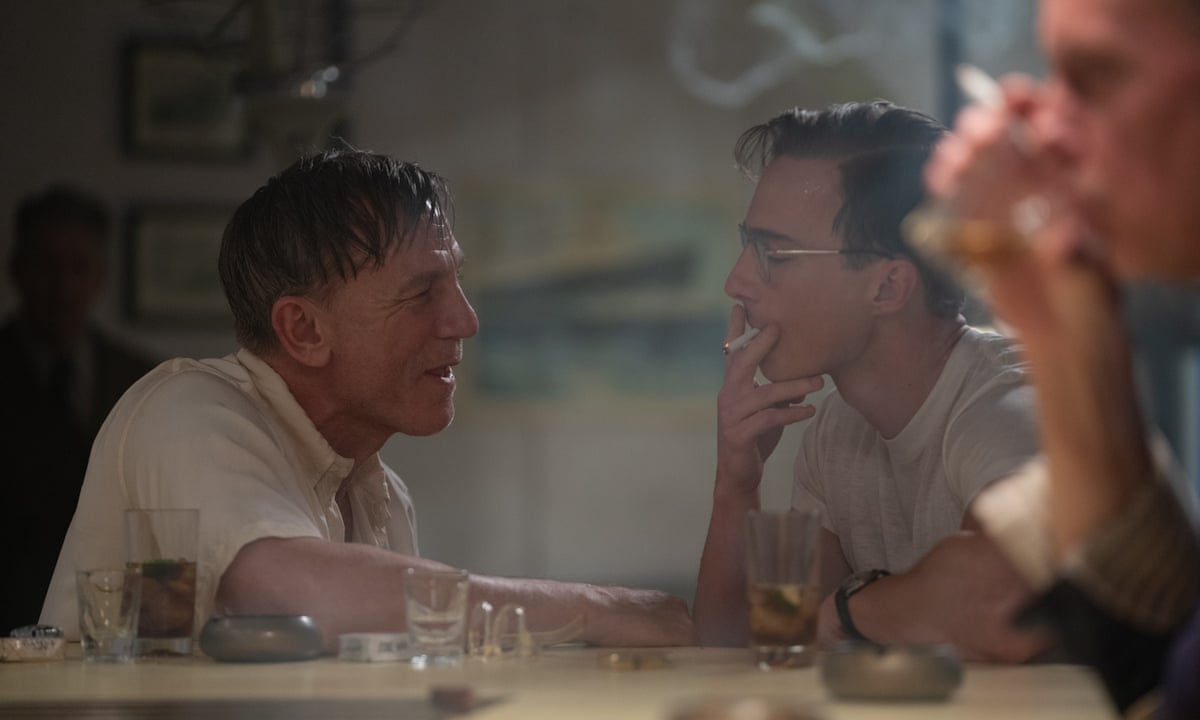
Daniel Craig – operating at his peak – is Burroughs avatar William Lee, a man of some means in a beige linen suit (the uniform of the colonial adrift), one of the aforementioned loaners who moves swiftly through the packs, darting into bars and barking drink orders, hiding his junkie eyes beneath the brim of his fedora. A younger man manages to catch his eye; a wiry, rakish journalist named Eugene Allerton (Drew Starkey) who frequents a number of the same local dives, tethered to a girl named Mary (Andra Ursuta). In Lee’s world there is but one question. The McCarthy question. Are you now or have you ever been? Only Lee isn’t looking for communists, and he can’t get a fix on Eugene, which only fascinates him further.
If Naked Lunch made Tangier the exotic hotbox of ’50s queerness, Queer‘s Mexico seems just as sweaty and restless. The grotty sex hotels. The languid rooms. Guadagnino makes Lee’s environment match the character. Past and context is only lightly shaded, leaving Craig to tease out the foibles and the fractures. His Lee has a desperation to him that’s both forlorn and energising. Starkey, for his part, is coolly unreadable. The film’s long, luxurious opening act is a woozy, lolling vibe unto itself. The hermetically sealed culture makes one think of the limbo port towns of Rainer Werner Fassbinder’s Querelle (another cruising classic). There’s a sense of rot and stagnation which might well explain Lee’s eagerness to remain flighty and on the move, even if he’s only ever dancing in circles. No wonder Eugene is cagy, wary.
This first hour swoons many times. Guadagnino wants us to understand yearning. In a handful of scenes Lee manifests ghostly extensions of his limbs that reach to touch and caress Eugene in ways he hasn’t yet been given permission to. These feel like overt displays but they land earnestly, like Queer is showing you its beating heart. It’s a film that wants. In reply, when it gets, it is as sensuous as anything Guadagnino – or anyone else – has offered us in a while. Challengers was vaunted as a steamy, sexy movie. To this viewer it was nothing of the sort. But Queer makes its sex momentous, overscored to perfection by Trent Reznor and Atticus Ross in steely shimmers of querulous synths.
Fassbinder isn’t the only filmmaker that came to mind. There’s something of the ghostly timelessness of Tsai Ming-liang’s Goodbye, Dragon Inn in Queer‘s front section. Of people haunting. Of there being nowhere to go, but also a sense of a thing ending. Entropy. Frankly, I couldn’t think of a higher compliment.
So it’s a bit of a knock when Queer enters its cooler second chapter, triggered by a ramshackle jaunt down to South America and into shivering portraits of heroin withdrawal, tested patience and Lee’s increasing obsession with finding a mythic Ecuadorian plant named Yaje, believed to have telepathic properties. It is these properties that Lee wishes to test, and while the tone and pace of Queer mutates erratically, this central desire – to finally know and trust someone – centres it’s detours into territories that feel more like a Hunter S. Thompson yarn.
It’s easy to find oneself mourning the first act as Guadagnino experiments, and the film’s third is it’s most freakish and comic, taking us further still from the heady rooms of Mexico City. But like a Burroughs monologue you have to take the absurdities and find the truth in them. Shaggy dog stories and meandering paths are weapons in his arsenal, and Guadagnino goes off on a ramble in the spirit of his author, teased out by his regular screenwriter Justin Kuritzkes. Lee’s yearning heart remains the core even at the film’s most wantonly strange. The visualisation of an hallucinogenic trip taken by Lee with Eugene even finds Guadagnino courting Cronenberg, seeking a new flesh. It’s a credit to the man that his gambit pays off, though it is perhaps a little overplayed.
If all this wandering makes Queer feel like it forgot its home, a touching epilogue brings us back to the man himself. Burroughs. Lee. One and the same. While one senses Guadagnino struggling to naturally conjure the kind of dream imagery that comes easier to other artists, he always tethers the emotional core of the film to these efforts, and so they work (sometimes in spite of themselves). The film’s final moments are simplicity itself, but are profoundly moving because they maintain this resonance. It’s among the best things Guadagnino has put forward. A giving ode to an inspiring artist.
In spite of its errors and peculiarities – indeed, in part because of them – I’ve fallen kind of hard for this knotty, try-hard, heady little travelogue. Some of the nods and winks feel as ungainly as the Easter eggs thrown into franchise fare. Clutter in the corners. But what Craig’s doing is too fascinating, too wretched, too wonderful for me to care all that much. If Challengers froze me out, Queer has pulled me right back in.
Like Lee, I’m rather itching for another fix.

 The Lost Highway Hotel
1 thought on “Review: Queer”