

Director: Andrea Arnold
Stars: Nykiya Adams, Franz Rogowski, Barry Keoghan
Anyone who spent time with Andrea Arnold’s 2016 road movie American Honey will know that the Dartford-born director can curate a soundtrack. That film carried with it one of the most impressive and eclectic playlists of the decade, channeling the free-spirited nature of it’s wanderlusting protagonist. Arnold’s 2021 documentary Cow didn’t leave much capacity for the same magpie magic, though the echoes of Radio One haunting the milking shed imbued that film with its own eerie quality.
For her latest narrative effort Bird – an adrenaline rush of cinematic images – she resumes her knack for a banging soundtrack. Stuffed as it is with prime cuts from Burial and Fontaines D.C., one recurrent pick furthers a furious political notion lurking within the text. Blur’s ‘The Universal’ occurs here in multiple forms. It’s original, a live version and a wedding karaoke iteration. The second single from the band’s fourth album The Great Escape, its a song synonymous with Britpop Britain and particularly the elated sense of promise subsequently squandered by New Labour and absolutely crushed by the ensuing Conservative governments. For a brief time the UK was optimistic, however, and Damon Albarn’s insistence that freedom in the next century “really, really, really could happen” resonated at a level so fundamental that it may not have properly registered at the time.
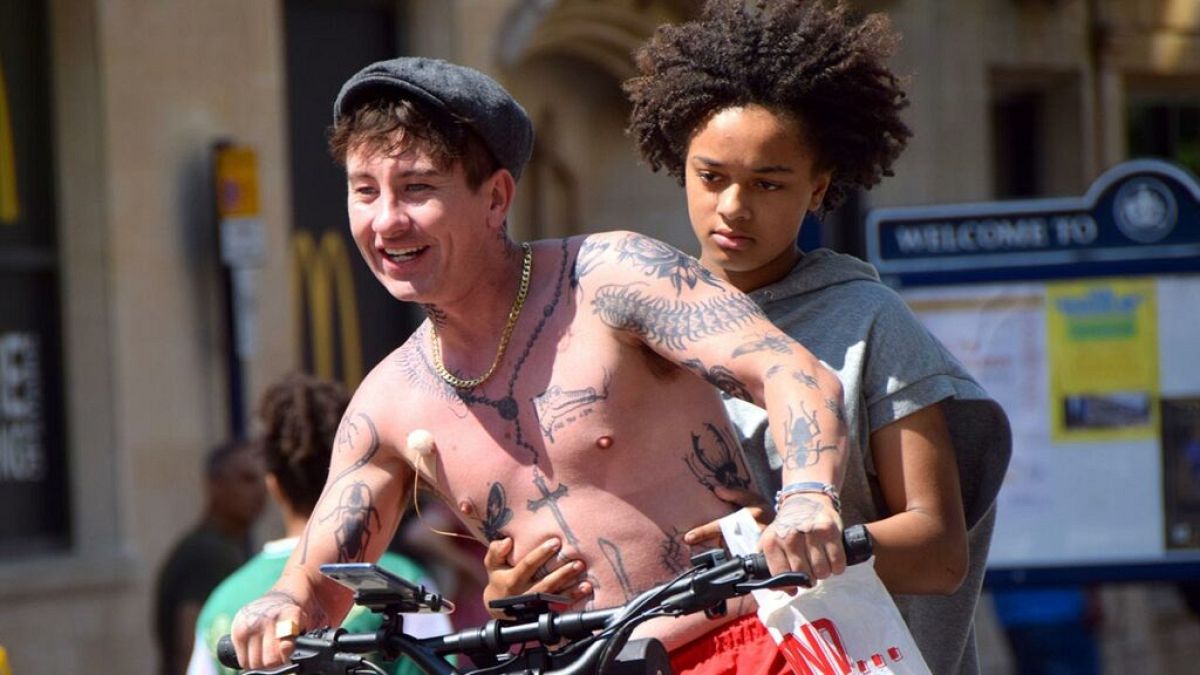
Bird takes place in an anonymous southern borough in the vicinity of the Thames and brings to bear some of the most abject squalor and poverty seen on British cinema screens in recent years; a continuation of Arnold’s unflinching, borderline-exploitative fascination with those living in the direst of straits. 12-year-old Bailey (Nykiya Adams) lives in a graffiti-daubed squat with her biological father Bug (Barry Keoghan) and her half-brother Hunter (Jason Buda). Across town, her mother lives with Bailey’s menagerie of younger sisters while shacked up with genuinely-terrifying thug Skate (James Nelson-Joyce). There’s no school for Bailey, and Hunter’s ties to a local gang of violent teenage vigilantes suggests a brutal future in store for the girl. News that her twenty-something father is about to marry his new girlfriend Kayleigh (Frankie Box) doesn’t exactly set Bailey’s world on fire.
From the very beginning Bailey and Bird toy with notions of escapism. The film opens with Bailey using her cell phone to make videos of a seagull that she later projects onto her bedroom ceiling. Not only do the images suggest the notion of flight and prefigure the arrival of a fantastic figure in her life, but the manner in which Bailey plays them – abstract slices of light caught in the midst of Arnold’s 1.66:1 boxy 16mm frames – feel like a communication from Arnold on what comes next for cinema. That through evolving technology the youth hold the form’s future in their hands, and that it might be taken back by the poorest in society and reframed in new and exciting ways.
Amid Arnold’s grim and grimy social realism (caught with frenetic handheld energy by cinematographer Robbie Ryan), Bailey’s aforementioned fantastical figure arrives in the form of Franz Rogowski’s androgynous stranger ‘Bird’, a man she meets on waking in a patch of green field, seemingly conjured on a mysterious wind that buffets Bailey while she’s pissing. Bird’s seeming innocence and naivety – combined with a knack for appearing and disappearing at will – suggest from the get-go some measure of otherness. In another universe at another time one might well imagine Robin Williams in a similar role. The two find strange commune together.
Bird is looking, helplessly, for the family he once lost, with only nominal notions that they once lived in the area. Where he has sprung from and where he has been are hazy mysteries. Rogowski – one of Europe’s greatest actors – imbues the character with a birdlike physicality. Not only in his swooping, effete prancing, but in his habit of climbing and perching on the surrounding environs, scaling the surrounding high-rises with his namesake’s nonchalance.
Family, its illusiveness, its fractal nature and even it’s threat of meaninglessness is all over Bird. Bug doesn’t really fit the mould of a father. He seems more like a child-grown-older, perpetually obsessed with earning untold fortunes from the hallucinogenic secretions of a toad he’s found (another form of escapist fantasy). If Bailey reminds us persistently of Sasha Lane’s Star from American Honey, Barry Keoghan has a little bit of the balletic magic Shia LaBeouf somehow conjured in that film. Don’t worry, there’s no incestual connotation in the connection I’m making, rather it feels as though Arnold hasn’t finished with these character types and is here finding new ways to tessellate them.
Yet as much as traditional family doesn’t exist in Bird (and as keenly as it observes-without-judging the prolific pregnancies among those at the bottom of society’s food chain) family constantly feels like the most pressing concern. It generates all of the film’s dramas and defines all associations. It drives Bailey to make an evil choice as an act of protection. With her younger sisters, Bailey – only just beginning her own womanhood – is a de facto mother figure. Bird, a lost soul looking for his parents, feels like the ghost of a child whose face has long faded from a missing person’s poster once taped to a telegraph pole. Even Hunter is making life-altering decisions that are rooted in notions of family.
If the set-up teases something in the sphere of magical realism, the third act moves us into more pointedly fantastical territory. Its not the first gloomy British film this year to do so. And while comparing Bird to Starve Acre feels like a bit of a stretch, there does seem to be something in the water at the moment. A boldness to mash and merge the genres that have made British cinema stale, squeezing from the mixture new and exciting ways of telling our stories. Bird is raw, depressing, frequently harrowing but also… light, colourful and magical. Arnold’s rambunctious clashing of sensibilities doesn’t always pay off. It can feel like a bit of a jaundiced hodgepodge at times. But it’s frequently exhilarating for it. Buzzing with the sense of a filmmaker and her team tearing up the rulebook in favour of whatever might be prognosticated from the fallen tatters.
It also feels incredibly angry at the betrayals of both New Labour, Conservatives… the whole bloody system, frankly. Not just neglect but abandonment. Even if it isn’t a particularly outspoken or literally political film, the absolute detritus of its setting makes this anger and distaste palpably clear.
 The Lost Highway Hotel
1 thought on “Review: Bird”