
Directors: Scott Buck, Bryan Woods
Stars: Sophie Thatcher, Chloe East, Hugh Grant
With their scripts for recent sci-fi thrillers – mega-hit A Quiet Place, mega-flop 65 – Scott Buck and Bryan Woods showed a knack for tense economy, milking situations for their dramatic value while, through the necessity of their scenarios, having barely a word spoken. Putting aside the relative success or failures of the finished films, if you’d only seen those two you might be wondering what they’re trying to avoid. And while there’s further evidence of their screenwriting and directing out there (lesser-seen horrors The Boogeyman and Haunt), Heretic feels like something of a riposte. Or possibly a coming out party.
Pre-release marketing materials lean heavily on two aspects of the film; Hugh Grant’s star-turn (we’ll come back to that) and the sense that his Machiavellian Mr Reed has some kind of labyrinthine Saw-style torture house in store for unwitting Mormon missionaries Sister Barnes (Sophie Thatcher) and Sister Paxton (Chloe East). While that’s true enough to a degree, it really undersells the main meat of Heretic. This is a verbose, researched and wittily presented interrogation of faith and organised religion, delivered as a kind of Halloween night horror sermon by Grant’s twisted theologian. It offers food for thought, and a lot of it.
Dialogue overspills even before these two get to Reed’s secluded cottage. The film opens with a slightly ham-fisted soliloquy about receiving divine inspiration while watching an amateur porno. It’s Heretic‘s most ungainly gambit, but it sets the tone for motormouth enquiries to come. Barnes and Paxton come upon Mr Reed one day while doing their rounds. His name’s on a list. And he invites them in with a smile and an offer of blueberry pie. They sit. They talk. But the tension mounts as his oft-referenced wife fails to materialise and as dusk falls and the lights keep popping off.
For around an hour Heretic unspools like this. It is deliciously engaging, playing up it’s Hansel and Gretel conceit. Each step leads Barnes and Paxton deeper into the house, which menaces with its gloomy corridors and indeterminable sense of scope. Paxton appears the more nervous, chatty and airheaded of the two, prone to lapsing into rehearsed babble whenever the conversation veers out of her comfort zone. Barnes senses trouble from afar, and Thatcher’s switched-on presence is an absolute boon to the character.
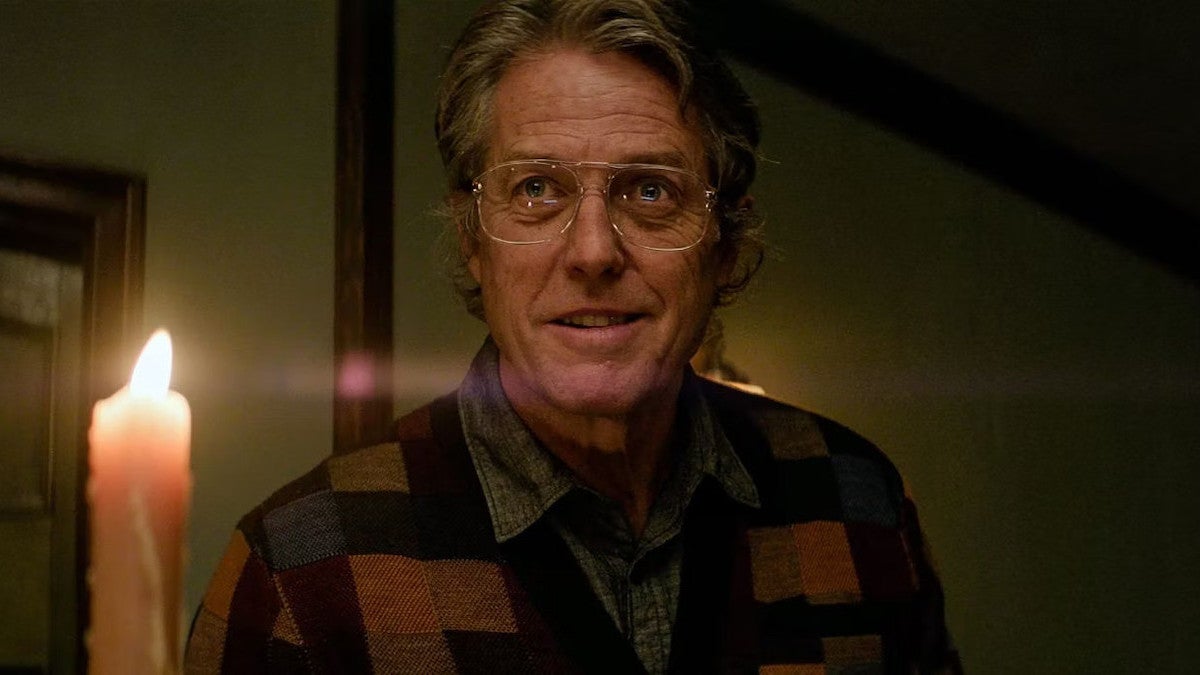
And then, of course there is Grant. He’s had quite a career rejuvenation since stealing the show in Paul King’s Paddington 2, and now seems game for more or less anything. Alas, Hollywood’s version of this has tended to be pantomime guest spots in the likes of Dungeons & Dragons and Wonka. Heretic gives him an incredibly thorny character to dive into and a great deal of chewy conversational conundrums to unspool. He’s wonderful, even weaponising a tinge of that innate, twee British humour to add a contrasting tension to Reed’s more menacing, accusatory nature. The script saddles him with a great deal of red herrings and deflections to deliver – which he does so with aplomb – teasing the audience as to where this is all heading.
With such a triumphant first half in the bag, Heretic runs into a bit of a problem when it comes to matching the expectations that have been built up so expertly. As we descend into Mr Reed’s devilish mix of Dante’s Inferno and Grand Designs, there’s a slight sag of “is this it?” about his underlying nature and intentions. At one point Paxton accuses Mr Reed of improvising, and it sort of feels as though Buck and Woods have started to as well. The push to the end seems relatively rushed and underwhelming, as though the film has been awkwardly compressed. And while visual nods to the likes of Eyes Without a Face suggest deep pockets when it comes to plucking out horror reference points, the sharp clarity of the film’s opening stretch starts to feel lost in the murk. Efforts to visually confuse or disorientate the viewer don’t quite mask the sense that there’s less here than we’ve been initially sold.
Which is rather ironic really, considering Buck and Woods’ committed sermon on the flimflam and hackery of organised religion. While the horror accoutrements are fun, welcome and season-appropriate (why wasn’t this out a week ago?), Heretic is at it’s most engaging and thought-provoking when its digging into the motivations of monotheism, into the histories and hypocrisies. The script does so with great nous, making Reed carefully remorseful when he furthers any idea that might alienate devout viewers, and putting pithy words of rebuttal and shade into the mouths of both Thatcher’s Barnes and East’s Paxton.
There’s a lot of sharp and effective work here, and Heretic often matches its wordy acumen with visual kicks, too (the appearances of a red bike lock are weaponised for maximum effectiveness). And above all else its thrilling to go to a multiplex and be confronted with a film that asks its audience to take away weighty ideas for further debate and consideration. That alone makes Heretic a must-see for the masses. If only it stuck the landing a little better.

 The Lost Highway Hotel
The way science fiction merges hard science with emotional storytelling is so engaging. It’s not just about space travel or futuristic tech, but the human side of it all.
Excellent movie and great review. What did you make of Sister Paxton’s passage through the series of rooms (towards the end of the movie) that contained esoteric books and paintings? How did this scene add value to the overall story?
I’d need to watch it again, which I hope to do at some point this year. I’ll keep an eye out.