

Director: Anna Kendrick
Stars: Anna Kendrick, Autumn Best, Nicolette Robinson
In the aftermath of the #TimesUp and #MeToo movements it was not uncommon to see another buzzy phrase touted, often with well-earned exasperation. “Believe women”. This novel concept needed shouting, as a backlash of chauvinistic skepticism would inevitably counter any new claim that came to bear. While the movement and its fallout in Hollywood has come to feel like an incendiary fire that burned hard and fast, cycles of dour public rehabilitation attempts (some successful) have made many feel weary of the fight. Anna Kendrick is here to remind us that vigilance is – and likely always will be – required.
Kendrick’s biggest hits have cleaved close to either her abilities as a singer (Pitch Perfect, Into the Woods) or have toyed playfully with her bright, wholesome persona (A Simple Favour, Life After Beth, TV’s Love Life), but there’s always been more to Kendrick than these rosy roles. Her connection to the mumblecore scene seems often forgotten, an arena oft pocked with knotty, flawed, humanistic roles. Her directorial debut – now streaming on Netflix – reveals a learned nous for sharp frames, clear blocking and a knack for the suspenseful, but also an affinity for both darkly addictive true crime tales and an evident concern that the entertainment industry hasn’t fully accounted for it’s treatment of women.
Kendrick herself stars as wannabe actress Sheryl Bradshaw. Struggling to make ends meet in the LA of 1978, she agrees to take a gig as a lonely heart contestant on hit TV gameshow The Dating Game (for UK readers, think Cilla Black and Blind Date). Thanks to a time-jumping narrative structure we’ve already been made aware that one of her potential suitors, Rodney Alcala (Daniel Zavatto), is more than he appears to be. Rod has a storied history of luring young women out to the desert to torture and murder them, but has eluded capture by the authorities going on 7 years.
While The Dating Game episode acts as a kind of fulcrum for the jumps back and forth along the timeline, anchoring Woman of the Hour, it’s the jumps forward that engender curiosity and worry in equal measure. We see Rod very much free circa 1979, picking up precocious tearaway Amy (Autumn Best) soon after she’s robbed a laundromat for petty change. The persistence of this story has a troubling effect on Sheryl’s misadventure on television a year prior, leaving the viewer deeply nervous of her fate. Especially as Rod seems adept at giving her all the right answers.
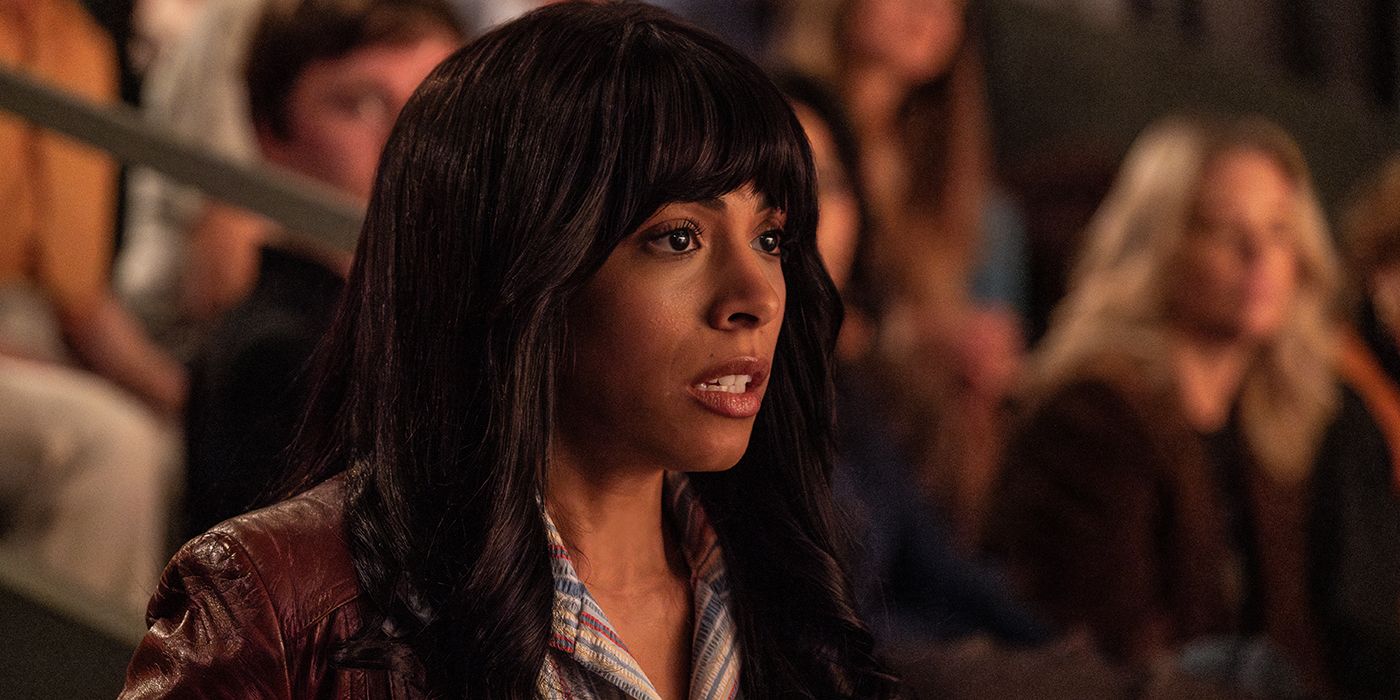
Indeed it seems for a time as though WotH is about to hand over its lead perspective to an audience member, Laura (Nicolette Robinson), who recognises Rod from an incident at the beach a year earlier. But her efforts to alert the authorities are frustratingly stymied, falling on deaf or incompetent ears. Sheryl, meanwhile, goes to show she’s no mere damsel in distress, and WotH is at its most enjoyable when she is given the autonomy to go off script and flex her wit and intellect with the unprepared bozos on the other side of the studio divide, putting them through their paces.
“What are girls for?” she asks, unlocking the broader questions surrounding a woman’s perceived role in society, a question interrogated throughout WotH. Long before Sheryl has made it to the studio she’s had to navigate scenarios with men who are by turns condescending, narcissistic, passive aggressive, lovesick, casually racist or vaguely predatory. Sheryl embodies the grit and patience required to simply be a woman in Kendrick’s America of the 1970s. The infuriating power of a placating smile. The inference that the world hasn’t evolved far beyond those years is right there for the taking.
Kendrick clearly relishes playing Sheryl, especially when she’s afforded the opportunity to bite back with abandon, but the actor/director is an equally compelling presence behind the camera, mounting an incredibly warm and handsome production. One senses that Zodiac might be one of her favourite movies, not just for the lurid aspect of a serial killer at large, but for the kindred aesthetic choices in presenting the ’70s as a period colour-coded with mustard and denim, greens and burgundies. There’s also a sense here that she is playing quite knowingly with the idea of a pointed camera being synonymous with holding a weapon. Rod’s cover of being an aspiring photographer lends her a dark reflection within the film. But where Rod’s intent is to manipulate and acquire victims, Kendrick is out to frame him as the callous – maybe even feeble – predator he would eventually be exposed to be.
But not without a toll. There’s a good deal of sobering on-screen text at the end of Woman of the Hour, after young Kendrick lookalike Autumn Best has been given her time to shine in the movie’s bleak and nail-biting extended coda (one feels terrified throughout this late section that we’re going to be left lingering in limbo, a fear Kendrick skilfully manipulates).
Said on-screen text points toward an epidemic of women speaking out to no avail (a role embodied within the film by Robinson’s Laura). And while women’s testimonies are ultimately the lifelines of this movie, their success is dwarfed by grim stats suggesting their exception to the rule.
Woman of the Hour‘s playful mid-section may be a showcase for Kendrick’s plentiful onscreen charisma but make no mistake, this is a sourly brooding contemplation on a continuing imbalance of the sexes that can quite quickly escalate to extremes of life or death. Kendrick means business.

 The Lost Highway Hotel