

Director: Francis Ford Coppola
Stars: Adam Driver, Aubrey Plaza, Nathalie Emmanuel
On, ‘Time’, the centerpiece of his glam rock opus Aladdin Sane, David Bowie opines, “Time, he flexes like a whore, falls wanking to the floor”. It’s an absurd, ungainly announcement in the midst of a symphony of excess, but it plays beautifully because of Bowie’s commitment to the bit. It echoed in my mind while walking home from Francis Ford Coppola’s similarly indulgent and inscrutable self-financed Megalopolis; a gaudy falling-Christmas-tree-bauble of a film. A work that is wholly’s its master’s creation, marvelous in its reach, but one that also vibes heavily with the old “come on grandma let’s get you back to bed” meme.
The grandmasters and mavericks of the ’70s are aging, and those who haven’t chosen retirement already are industriously passing us grand gestures. Scorsese’s sweeping trio of Silence, The Irishman and Killers of the Flower Moon make a bid for his finest run of all (not an insignificant claim). George Miller made Furiosa an uncanny extension of his lifelong Mad Max mythos.
Coppola already split from conventional filmmaking decades ago, working around the margins on smaller, spikier personal projects. Megalopolis continues in this mode, rather than feeling of a piece with his more celebrated, populist epics of old. Those expecting another Godfather will be flummoxed. And if it has the creative ambition of Apocalypse Now, it is far removed in almost every other respect (it does have Laurence Fishburne, though). The stagey aesthetics of One from the Heart and the wide-eyed ambition of Youth Without Youth might be more apt touchstones, but it’s still singular, even in such a diverse filmography. And, like Bowie, like Scorsese, like Miller, it is preoccupied with the inexorable power of time.

Subtitled ‘A Fable’ to soften its sledgehammer blows, Megalopolis takes place in the 21st century of the Third Millennium (suggesting that Coppola has his own ideas of how time works). The American empire is in its final decline, and New York has become New Rome, a glittering circus of socialites and the marginalised, rioting poor (only ever a hollering background noise). In this arena, Nobel-prize winning city planner Cesar Catalina (Adam Driver) vies with Mayor Franklyn Cicero (Giancarlo Esposito) for supremacy. Though, it has to be said, Cesar is far more preoccupied with his new-found ability to fleetingly freeze the flow of time (pure romantic wish fulfillment from Coppola, and moving because of this nakedness).
A great many players flank both houses. Nipping particularly at Cesar’s heels are his power-hungry uncle Hamilton Crassus III (Jon Voight, looking like Dame Judi Dench cast loose from shooting a ‘Money Super Seven’ ad) and odious nephew Clodio Pulcher (Shia LaBeouf, channeling Jared Leto). Wall Street newscaster Wow Platinum (Aubrey Plaza) shares Cesar’s bed, but has her own honeytrap plans elsewhere in the family lineage. Amid all this chaos and chatter, Cesar is drawn to the daughter of his rival, Julia Cicero (Nathalie Emmanuel), as he sets in motion plans for his coveted city-within-a-city – the titular Megalopolis! – a place of dreams and endless travellators.
If my tone is a little caustic it is perhaps because Megalopolis encourages a kind of snark or snideness that I am not immune to. A lens through which it’s easy to dismiss as a grand folly, and I certainly witnessed this in the sparse audience to the film. A contingent seemed over-ready to enjoy Megalopolis ironically rather than engage with what it was up to. The sincerity of its excesses encourage this. Cesar regurgitates a lot of Shakespeare. Scenes take place on timepieces atop skyscrapers. There’s an entire Colosseum-set circus performance-cum-pop concert. Largess invites ridicule.
And yet, there’s so much going on inside this confused and glimmering artefact. And so much of it is Coppola trying to wrestle Big Ideas to order. He stumbles, big time. But the effort is laudable and the results never less than fascinating to sit in front of. I wasn’t bored for a second of its 138 minute running time. Indeed, the sprawl of Megalopolis felt disappointingly curtailed, its salient points often condensed into montage where, one senses, Coppola would have preferred the additional mileage to expand and ruminate. I guess there are inevitable constraints even when you’re operating unchecked outside of the studio system.
Entering his twilight years there’s a pained desire for more time, yes, but Coppola also wants to talk sentimentally about love, family, and – err – celebrity deep fakes. Cesar is obviously his avatar here (and there’s some self-awareness in his well-meaning megalomania), but in truth Coppola pieces himself out everywhere. Mayor Cicero would much rather be called Francis by his friends, and there’s a baby Francis here, too; an innocent who is even given the curtain call (a strained nod to Kubrick but also how we create immortality through generations?).
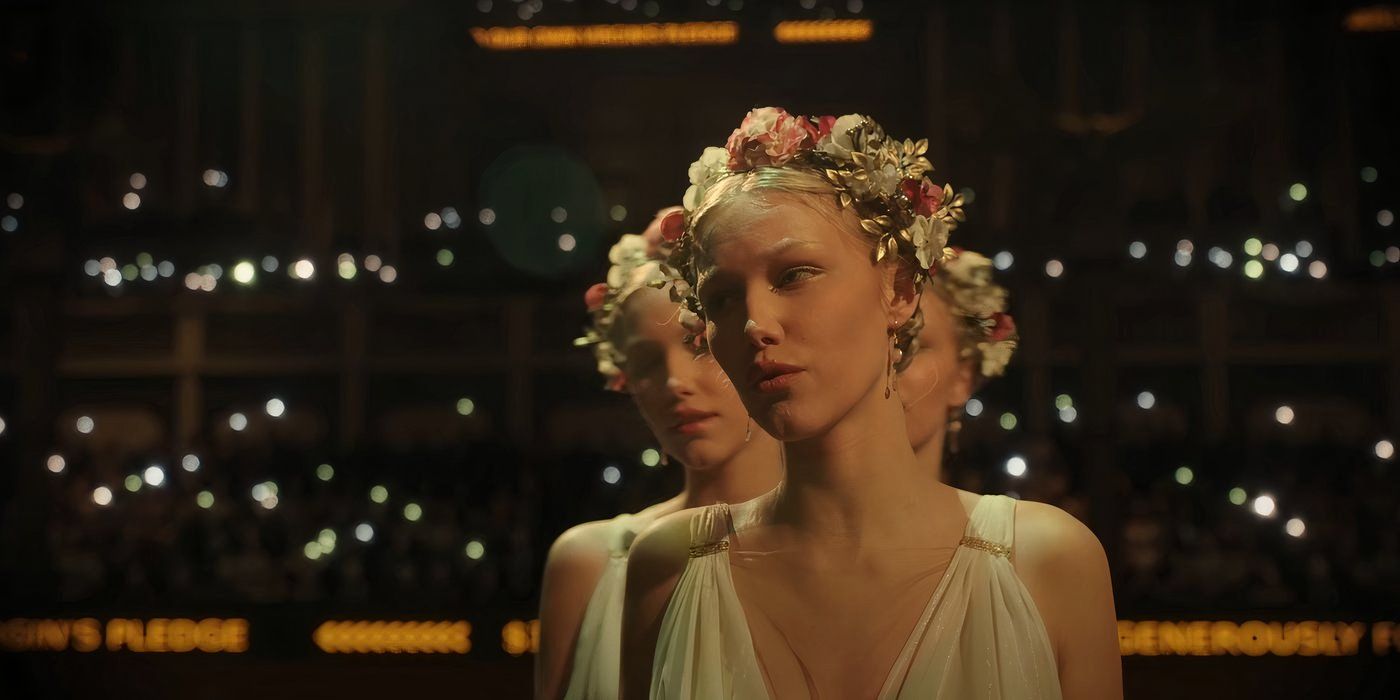
One senses that Coppola feels like a man out of time when it comes to dealing with the shallow spectacle of the socialite world, perplexed by digital manipulations of the truth. He doesn’t understand spotlight-hogging fools like Pulcher (a quasi-Trump facsimile; LaBeouf’s second such role), and it is perhaps telling that – for the most-part – Cesar sidesteps between the rabble as Megalopolis soldiers on. Not even their bullets can stop him from rebuilding anew. He’s an artist, not a politician.
There’s a dizzying amount of information here to condense into a pithy review on first flush. But it is quite the experience. Messy (complimentary), garbled, sometimes glorious, always kinda weird about it’s women. You might liken it to Richard Kelly’s Southland Tales and you’d have a point. You might liken it to Tom Hooper’s Cats and you’d have a point. But you might also liken it to golden-era Fellini (La Dolce Vita, 8½, I Clowns and Satyricon especially) and you’d have a point. Such grandiose gestures have fallen out of favour in recent decades, making Megalopolis feel flung from some distant star. You might say we haven’t seen such a dazzling grotesquery since Tim Burton’s vision of Gotham, and you’d have a point, too.
This is the unhelpful nature of Megalopolis. It is as confoundingly sincere and myopic as its own protagonist Cesar Catalina, speaking soliloquies from the heart to a crowd that probably aren’t able to hear him. It’s nowhere near as coherent as the other grand statements made by our elder statesman of cinema listed somewhere above, but it is singular, and I’m very glad it’s out there, spinning to the music of it’s own spheres.
It’s worth more than just mockery. Probably.

 The Lost Highway Hotel
1 thought on “Review: Megalopolis”