
Year: 1987
Director: Éric Rohmer
Stars: Joelle Miquel, Jessica Forde, Philippe Laudenbach
Summer is ending. Not that we’ve had much of a summer here in the UK in 2024, but still, you can feel the changes. I’m slowly getting back to the stack of folded jumpers in my wardrobe. The thicker duvet is back on the bed. Excitable people on social media are posting about “spooky season”. Chances are we’ll get a last faux flush of good weather. A final faltering heatwave lasting a day or two and then that’ll be it. The nights will draw in and cosiness will return (I’m a big autumn fan, so that’s good news to me).
But I’d be lying if I said I wasn’t wistful for summer and, as a film fan, wistful for depictions of summer that seem to sing. Éric Rohmer’s diaristic studies of French summers peppered the 1980s and quickly became catnip for the bourgeoisie and middle classes. Art house sensations. Many of his best are collected up in the Comedies and Proverbs cycle that encapsulates the likes of Pauline at the Beach, Full Moon in Paris and the ever-revered The Green Ray. Sitting quietly and coquettishly at the end of this run is the gangly-titled Four Adventures of Reinette and Mirabelle; probably this writer’s favourite of them all, and the one I found myself reaching for while contemplating the end of summer.
Split into episodes and introduced with a cutely naive electronic jingle, we begin in ‘The Blue Hour’ and a typically picturesque Rohmer country scene. Mirabelle (Jessica Forde) is cycling and happens upon Reinette (Joelle Miquel) when she gets a puncture. Reinette industriously helps her to patch the tyre amid the verdant overgrowth and the twitter of birds. ‘The Blue Hour’ takes place against a quaint backdrop of humble rural living. Reinette lives in near squalor in a repurposed hayloft but, in Rohmer’s hands, its a giddily romantic notion.
The story’s title is tied to a romantic sense of rural reverence. Over a garden table meal, Reinette speaks of the titular Blue Hour as a moment right before dawn, only two or three times a year, when all nature falls silent in anticipation of the coming day. The two of them commit to seeking it out and become fast friends.
Four Adventures quickly conjures a playful, rascal spirit between its two leads that recalls the sense of play inherent to Jacques Rivette’s epic of childlike glee Céline and Julie Go Boating – another study in female friendship that exhibits a kind of wonder usually lost somewhere in the fade of adolescence. Rather than infantilising their young leads, both Rivette and Rohmer long for what’s lost to be retained into adulthood, proffering us an idea of the sensible and the frivolous co-existing in the same body(ies). Reinette has desires for her future – to go to Paris, to study art – and is quickly fascinated by Mirabelle for her cosmopolitan origins.

The preciousness and hushed significance of the Blue Hour recalls the titular wonder of Rohmer’s prior film The Green Ray, where we seem to glimpse the miraculous at the picture’s conclusion. Here, though, the silence is ruined by a passing tractor leading Reinette into a tearful tirade at the cruelties of life. Four Adventures is frequently a coming-of-age film, lightly pressing its twin heroines to confront the world’s inescapable aggravations and disappointments. That few things are totally within our control, and that’s maddening. In this precocious picture, however, despondency is quickly forgotten when there are goats to play with and cute music to dance to. Plus, there’s always tomorrow.
In ‘The Waiter’ we catch up with Reinette and Mirabelle in Paris. They’ve evidently moved in together. Immediately Rohmer shifts the palette to acclimate us to the urban environs. Washed of grey walls that compliment dreary skies. Clothes like sheets that camouflage the girls. At a cute little cafe, Reinette contends with Philippe Laudenbach’s riotously cantankerous waiter while herself waiting on Mirabelle. Rohmer warms us up for the extended bit with a shorter sketch between two men disagreeing on directions in the bustling thoroughfare, before rolling out one of his broadest and most enjoyable pieces of situation comedy. Laudenbach steals the segment. His garcon may be a caricature but, for anyone who’s worked in retail or service, there’s some puckish wish fulfilment to his brazen ability to mistreat customers. In fact, we get to have it both ways, as the late-arriving Mirabelle has no qualms going toe-to-toe with his indignation. Again we join the characters in negotiating the minutiae of life’s disappointments.

Moving on – because there’s no dwelling when you’re young – episode three is ‘The Beggar, The Kleptomaniac, And The Hustler’. Reinette interrogates Mirabelle’s sense of charity after she ignores a homeless man on the street, leading to an outpouring of conflicting ideologies caught in hasty handheld in the middle of the city. It’s a cliche to say a city is a character in a film, but now that we’re accustomed to our setting, Rohmer observes Paris and makes Four Adventures a deft postcard of time and place, from fashions to architecture to attitudes and malaise.
Ownership and entitlement come in to play as, after their conversation, Mirabelle witnesses a seemingly well-to-do woman stealing from a supermarket. The on-hand security have a handle on the situation, but Mirabelle inserts herself into the drama, pinching the stolen goods and allowing the thief to escape arrest. She tries halfheartedly to rendezvous with the thief, but without success, allowing her and Reinette to have a fancy dinner together on the gains of her light fingers.
The sequence bristles with a youthful disdain for capitalism, authority and corporate greed, but this is sweetened by Rohmer’s deference for comedy – of course it’s Reinette’s birthday and she merrily assumes her friend has remembered. Mirabelle recounts her story and the heated ideological debate resumes, both young women affirming their perspectives, growing stronger and resolute in their beliefs. The viewer is invited to pick a side, but the characters are further revealed in the discussion. For all her indignance and moral superiority, it is Reinette who is duped by a cameoing Marie Rivière who plays a train station hustler prefigured in the segment’s title. The episode suggests that Rohmer’s politics skew closer to Mirabelle’s on this occasion. Still, he finds something romantic in Reinette’s kindness. Something we could all benefit from… if not monetarily.
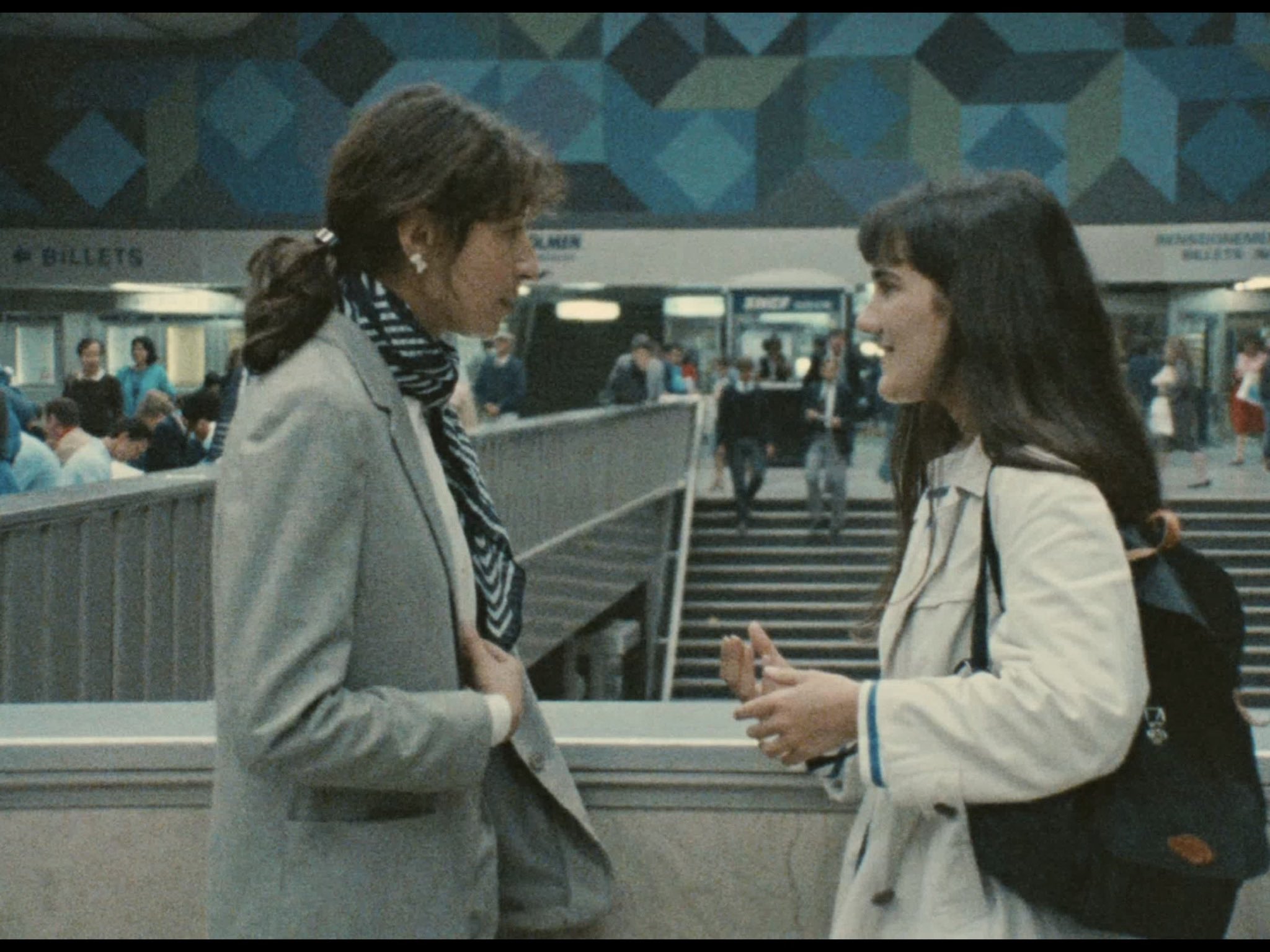
Finally, in ‘Selling The Painting’, impending penury (possibly because she’s giving all her money to strangers) has Reinette in a state, contemplating a return to the countryside because she is broke. Her solution? Contact a gallery owner about selling one of her paintings (an artistic flare seeded way back in ‘The Blue Hour’).
After bickering with Mirabelle over her chatterbox nature (wryly proving her friend’s point), Reinette offers a bet that she’s can’t stay quiet; something that immediate seems destined to impinge on her ability to sell her painting. Mirabelle offers to let her out of the bet – understanding that fiscal responsibility is a crushingly serious reality – but Reinette insists on sticking to their agreement, furthering her childishly skewed priorities. And so we end on an extended sequence of farce, as Reinette attempts to peddle her work to Fabrice Luchini’s eager connoisseur without saying a word. Luchini – allowed free rein against a silent Miquel – chews the scenery with pleasing indulgence, the biggest guest player since Laudenbach’s waiter.
That the gallery owner ultimately ends up haggling with himself – and then Mirabelle – into paying over the odds once again places Rohmer right alongside Mirabelle, intellectually. He seems to agree that motormouths talk themselves into tight spots, is amused by it, and asks us to be, too. But again his affections are for Reinette. Mirabelle launches a confidence trick to save her friend, at the same time furthering the position that talking too much is inherently vulgar. Its self reflexive from Rohmer, as many of his most favoured films run freely at the mouth. A playful bit of self-criticism.
Ultimately, it brings us right back to ‘The Blue Hour’ and the concept that silence is golden. The final transaction is completed wordlessly. A victory for our heroines. Indeed, each vignette of Four Adventures feels in conversation with at least one of the others, making it feels interconnected and not just an arbitrary jumble of sketches. Rohmer even pre-empts gasbags like me taking too much reverence from his work. Once Reinette and Mirabelle exit the gallery, two browsing patrons enquire about Reinette’s painting. The picture comes to an end on a hard, sharp punchline as Luchini swiftly, casually jacks up the price. A pithy comment on the nature of commerce, but also another sly in-joke from Rohmer on applying too much value to something meant to be enjoyed on its simplest terms.
So let’s back peddle, and remember the reason for this series of essays. Why do I love it? It’s a bonbon. A confection. Substantive if I reach for it, but more immediately light, sweet, fleeting in its piquant pleasures. Miquel and Forde are delights throughout. And the energy is as exquisite as the gorgeous 16mm grain.
And, ultimately, its one of the perfect end-of-summer films. Because it zeroes in on those years when childhood (summer) defaults to adulthood (an encroaching autumn), and wistfully posits that one needn’t end for the other to begin.
 The Lost Highway Hotel