

Director: Pascal Plante
Stars: Juliette Gariépy, Laurie Babin, Élisabeth Locas
Courtroom drama has enjoyed a mild resurgence in arthouse circles in the past few years, between Steve McQueen’s Mangrove portion of Small Axe, Alice Diop’s impeccable Saint Omer and the Palme d’Or winning crossover hit Anatomy of a Fall. Now joining the fray – and as captivating as any of these – is Pascal Plante’s austere Quebecois offering Red Rooms; a coldly riveting case study of a particularly despicable crime that sprawls out in dangerous directions via a member of the gallery.
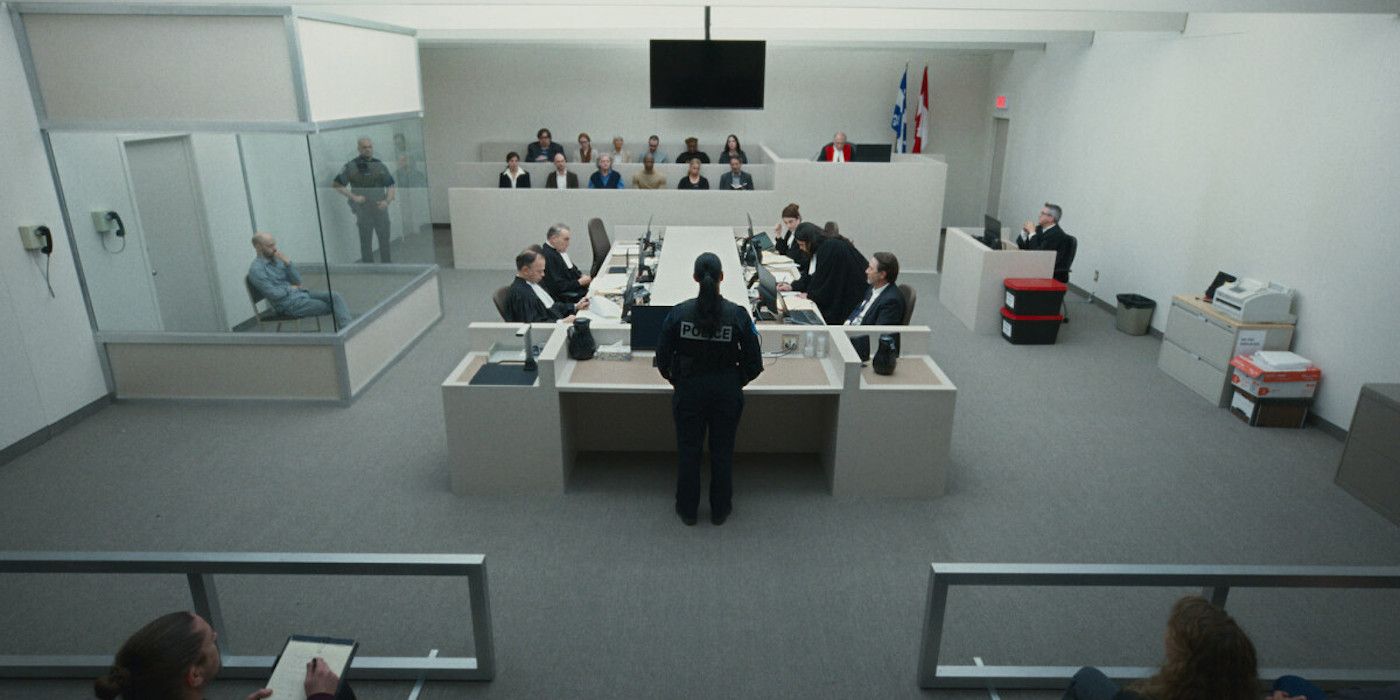
Ludovic Chevalier (Maxwell McCabe-Lokos) is on trial for the torture and murder of three teenage girls, supposedly conducted live to a select audience on the dark web in what is known as a ‘red room’. In a breathtakingly controlled, roaming 15 minute shot, Plante’s camera glides ominously around a futuristically white courtroom while prosecution and defense make their opening statements, beneath the ever-present hum of the building around them. Indeed, the subtly industrial ambient sound underpinning the quietude is as effective and oppressive as, say, the background noise layered into The Zone of Interest. A nagging echo of the eerie, persistent quietude of modern machinery. In this case, akin to the sinister cumulation of a thousand laptops and a reminder that, even by watching his fictional intellectual exercise, we’re to some degree culpable in its (unseen) violence.
Present in the court and a frequent distraction for DP Vincent Biron’s wandering camera is a woman named Kelly-Anne (Juliette Gariépy), who has been sleeping rough just to secure herself a spot in attendance every day. Who is she? How is she connected to the case? When stopped by a reporter on leaving for the day, she merely replies that she’s curious. Red Rooms goes home with her, and we get a peak through the door of her life. A professional model and ruthless online gambler, Kelly-Anne’s demeanor in front of her own devices is intense. Her apartment is almost as sparse as the courtroom. She clearly values security and privacy. A proto Lisbeth Salander perhaps?
The hum of machinery is echoed in the rushing wind heard at Kelly-Anne’s high-rise apartment during her adept and focused home investigations into the case, where she shows plenty of skill navigating on and off of conventional sites, gleaning passwords and accesses to further her inquiries. When testing her comfort zones on the dark web, Dominique Plante’s score (deliberately) echoes the stalking stretches of Mica Levi’s work for another Jonathan Glazer film; Under the Skin. These stretches contrast with the persistent chatter she tolerates when in the company of fellow courtroom addict Clémentine (Laurie Babin). That she has at least one like-minded obsessive tilts us to Plante’s broader commentary on the allure of true crime; that western society is addicted to its grimoires, suggestive of a morbidly biased cycle not wholly divorced from the crime being prosecuted in this case.
There’s an interest also in the polarising nature of media discourse that surrounds high profile news stories. Clémentine gets riled up watching a late night talk show about the case and makes an impassioned call-in, against Kelly-Anne’s cautioning. Her tearful tirade in defense of Cheavlier not only vocalises her own already-evident bias toward the suspect, but the panel’s dismissal of her position underscores – through mockery – an intolerance for counter argument.
Plante’s poise is riveting, conjuring the same aggression and clinical insistence found in the likes of Haneke, Breillat, Ducournau. Gariépy is every bit the equal in her ability to transfix and bewitch, taking us up to and over comfortable thresholds with chilling, unblinking eyes. Kelly-Ann’s transgressions are equal to her level of obsession, making for genuinely terrifying viewing come the film’s maverick set of climaxes. We’re stuck grimly pondering the lengths her pursuit will lead her to.
Wanting to see. Having to see is at the heart of the ethical and philosophical quandaries at the heart of Red Rooms. We, the audience, get close. We see others watching the unspeakable. Do we yearn for our turn? Kelly-Anne’s ability to disassociate and compartmentalise (like the ‘victims’ of her online poker playing) suggests a facility for handling extreme violence, but to what extent is it also a craving? What separates the watcher of these crimes from the perpetrator? And where do those boundaries lie for any of us? Red Rooms interrogates voyeurism in ways that can cut uncomfortably close to the bone.
Now that technology has enabled the dark fantasies of Cronenberg’s Videodrome to become a plausible possibility, it was only a matter of time before someone made an exacting enquiry into the kind of world we have made that facilitates such things. Frankly, who could have reasonably anticipated as steely a vision as Pascal Plante’s?

(Personally, I also hope any success that Red Rooms garners will allow better access to Plante’s excellent prior feature Nadia, Butterfly, cruelly lost in the shuffle during the COVID-19 lockdowns; one of my favourite under-the-radar efforts of the past few years.)
 The Lost Highway Hotel
1 thought on “Review: Red Rooms”