
Directors: Nathan Zellner, David Zellner
Stars: Riley Keough, Jesse Eisenberg, Christophe Zajac-Denek
Walking home yesterday evening I encountered a strange man. Presumably under the influence of some kind of stimulant (although far scarier if not), this small but guttural individual was striding down the middle of the road shouting “Fuck it!” “Wanker!” and “Smashed your missus!”, sometimes at passers by (myself included), but sometimes at nobody at all. Having passed me (mercifully without incident), his path crossed with the gentrified corner pub I had just walked by, the kind with a few nominal wooden seats out on the pavement. When one of the patrons responded to a “Wanker!” with a curt “Shut it”, our agitated crusader rushed him at speed, making contact with a headbutt. I can still recall the ‘crack’ sound of it. The patron’s mates rallied. Fearing violent encounters in the street, I hastened my path away from the ensuing tussle.
This little bout of impromptu street violence and the base motivations and responses of the man who provoked them seemed oddly droll in the aftermath of my evening’s entertainment, which had been the Zellner Brothers’ new film, Sasquatch Sunset. In this comedic curiosity we follow a foursome of mythical Bigfoots (Bigfeets?) through the seasons of one calendar year in the deep wilderness of the Pacific Northwest, observing ostensibly neanderthal behaviour for the better part of 90 minutes. Basically, if the first chapter of 2001: A Space Odyssey is your favourite bit of the Kubrick classic, boy do the Zellners have a movie for you.
Featuring the barely-recognisable likes of Jesse Eisenberg and a surprisingly soulful Riley Keough, Sasquatch Sunset has the feel of an early Daniels joint like Swiss Army Man, i.e. a risibly crude high concept movie designed to provoke comment for being kooky as opposed to anything richer. The Zellners’ sasquatch have no language, and communication is narrowed to the odd succession of grunts and woops as this mostly-directionless quartet (rounded out by Nathan Zellner himself as The Alpha and Christophe Zajac-Denek as The Child) prowl the great North American forests presumably in search of more of their kind. Along the way we’re treated to gruff mating rituals, bouts of explosive pissing and shitting, and the odd snort from the backend of a skunk.
For a long time its impossible to gauge when in history this anthropological fantasy piece might be set – so completely removed from the touch of humanity is the family’s roaming ground – but watching the behaviour presented, one wonders how this species has managed to go unseen or recorded. Galling stupidity is the order of the day, from a not-particularly-funny through-line of Eisenberg’s Young Male struggling to count to four, to The Alpha’s chaotically doomed experiments with fermented berries, magic mushrooms and a wild cougar. Darwinism is exhibited mercilessly.
If this was intended as a treaty on how far we’ve come, my foul-mouthed, headbutting street menace acted as a wry retort to the Brothers Zellner.
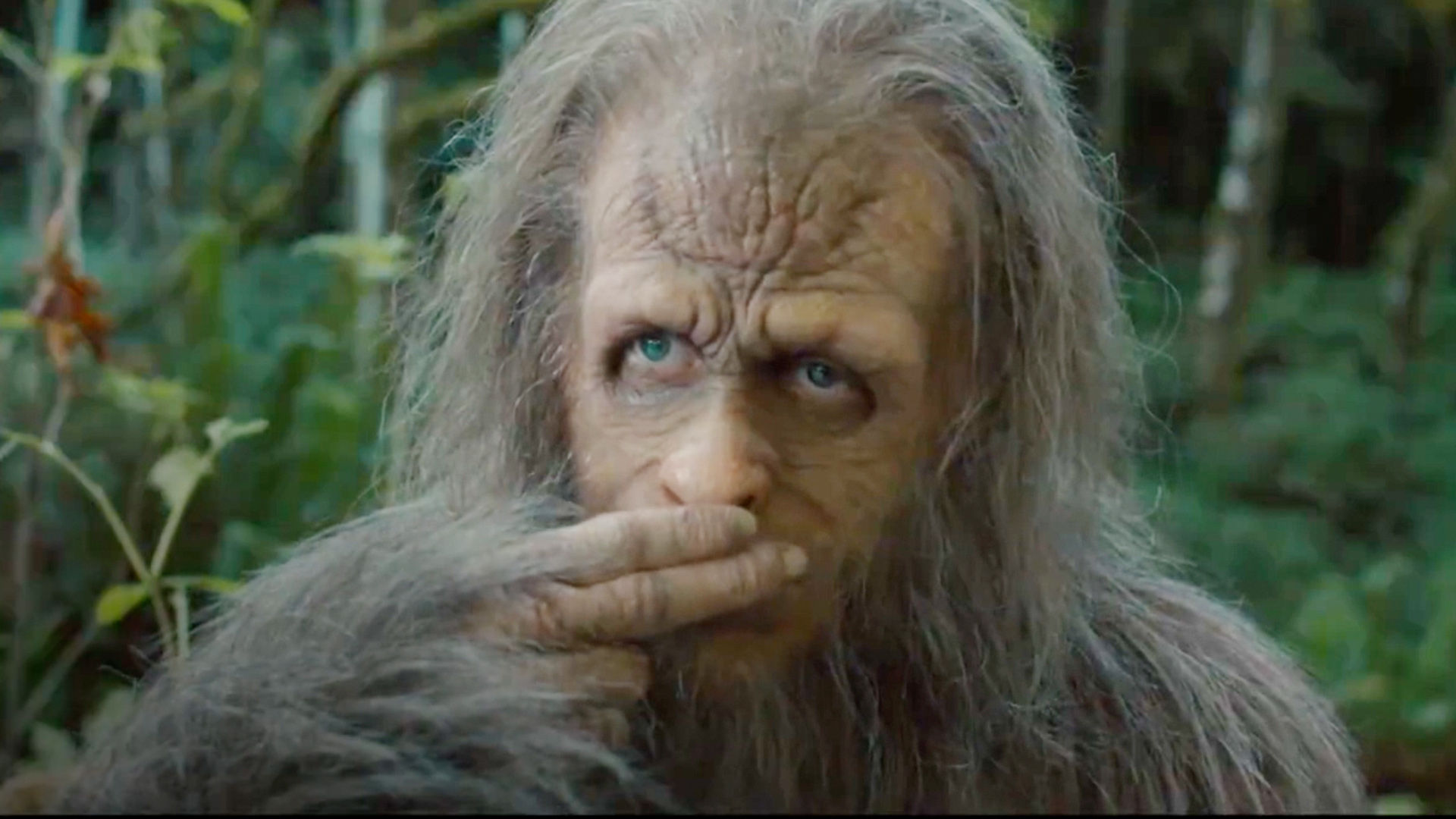
But as Sasquatch Sunset progresses through the seasons – and as the family edge closer to the boundaries of so-called civilisation – something unexpected starts occurring. Pathos. The Zellners tap into a melancholic strain of environmentalism here. Every glimpse of something man-made comes with an implied sense of foreboding, as though it is simply inevitable that our blithe monstrousness will spell disaster for these endangered beasts. Really without pressing too hard, the Zellners conjure a sense of a reducing habitat, of encroaching industry, and of the passive threats to ecosystems that those things engender. It helps their case that, as the thin narrative unfolds, Riley Keough’s Female develops a more central footing. The most emotive performer by far in this unlikely troop, her resigned eye work here is really second-to-none.
Despite a relative dearth of output, the Zellners have been busy in the years since their metatextual triumph Kumiko, the Treasure Hunter, most recently on the small screen with Nathan Fielder as part of the creative team behind The Curse. Still, it’s felt like an age since Kumiko captivated on the canvas of a cinema screen, and so Sasquatch Sunset feels like a bit of a wildcard despite the brothers’ evident predilection for the offbeat. They are helped immensely by the eclectic musical accompaniment provided by The Octopus Project, whose score trades in folk-rock melodies as often as it does the blurts and farts of Bitches Brew-era Miles, often adding a comical sense of gravitas to the most broadly played of bodily escapades. The other MVP is surely cinematographer Mike Gioulakis who frames this impressive wilderness with warmth and texture.
The finale manages to hit two polemic beats at once, reading as both honestly funny and startlingly sad. This dichotomy sums up much of Sasquatch Sunset. A patience-tester that is prone to moments of sincere inspiration or slapstick gold. As much mileage as the film gets from mocking the poor unevolved brain centres of it’s quartet of case studies, its as sobering to look around ourselves in the aftermath to question just how elevated we truly are.

 The Lost Highway Hotel
2 thoughts on “Review: Sasquatch Sunset”