
Year: 1980
Director: Jean Rollin
Stars: Brigitte Lahaie, Alain Duclos, Dominique Journet
Having spent the late ’60s and much of the ’70s self-financing his own mercurial vampire movies to little-or-no box office reward, Jean Rollin ended the decade slumming it in hardcore pornography, using the income from such gigs to get the ball rolling on whatever his next supernatural fairy tale was going to be. It was in this capacity that he came into contact with rising porno star Brigitte Lahaie, one of the most striking young French women of her time who not only had aspirations for more traditional acting work, but the presence and ability to make such a transition.
Lahaie appeared in Rollin’s more explicit cinematic detour Vibrations sexuelles in 1977 before advancing to the lead antagonist of his cult hit Fascination in 1979; a mixed-bag of a movie with a strong following, one most memorable for the image of Lahaie brandishing a scythe, standing in opposition to the camera.
But, for me, her defining role – and defining appearance for Rollin – is his mildly off-brand sci-fi horror The Night of the Hunted from 1980; a disquieting, stunningly atmospheric tale with the aura of early Cronenberg and peak J.G. Ballard about it, one that moves hypnotically through phases, reckoning with disparate subject matter as it goes.
It’s most awkward section is its opening, one that feels a little too influenced by Rollin’s recent stint in lurid skin flicks. Amnesiac Élisabeth (Lahaie) is discovered screaming in the dark by hapless passing motorist Robert (Alain Duclos). A good samaritan who stops to help her, Robert takes her back to his apartment where the two wind up having sex. Not only does this feel predatory on Robert’s part given her fragile situation, Rollin keeps the scene going for an inordinately long time. Indeed, it feels longer than the entire set-up to get us there. I’m far from anti-sex in movies – I’ve sought out some of Lahaie’s other work since being transfixed by her here – but at the top of The Night of the Hunted (ostensibly to be considered a comparatively ‘legitimate’ film) the balance feels conspicuously off. Awkwardly, so.
Two things arguably save it. The first is Élisabeth’s psychology of only having the present to hold onto. She has been rendered a pure sensationalist, reveling in the immediacy of any experience, however fleetingly. The second is Lahaie’s performance. Already a seasoned performer of sex on film, she is not as hyperactive as one might expect from latter-day pornography. Rather she keeps character. In combination with the former facet, the scene – while overlong – just about excuses itself.
The picture that follows it, however, might be damned near perfect, and would make an astounding double-feature with kindred hidden-gem Messiah of Evil (already covered in this essay series), sharing as they do an ineffable vibe of quiet, desolate apocalypse.
The relentless displacement felt by Élisabeth (and emoted so effectively by Lahaie) is terrifying enough as a hook, but The Night of the Hunted compounds it. With comic abruptness, Dr. Francis (Bernard Papineau) and his assistant Solange (Rachel Mhas) arrive at Robert’s apartment before Élisabeth has had time to even dress. They know her, and take her into their care in the pretext of taking her home. Unable to articulate why, Élisabeth feels resistant and distrusting of them, but has little other recourse, not remembering her own address. They take her to a gigantic glass skyscraper – one of the most monolithic and featureless buildings to have been constructed in Paris at that time, and a symbol of the coldly faceless corporate – and it becomes her prison for much of the movie.

It is here that The Night of the Hunted comes to feel Ballardian. Not just redolent of High-Rise, but of a number of books that the British author wrote in the ’70s that spoke to humanity’s perilous rush to reconfigure the environment in concrete, glass and steel. Books like Concrete Island and the notorious Crash evoked a sinister psychopathology in our obsession with manmade objects and topography. That by paving over the natural world we were creating emotionally inert arenas in which our more extreme natures might exert more power. Where eroticism, violence and primitivism might take us over, searching for new ways to understand the artificial landscapes we’ve created at a pace faster than evolution.
The interiors of the ‘black tower’ are clean, bright, but brutally minimalist, enhancing this sense of eradicated memory just as the building has eradicated the world that preceded it. Rollin depicts urban development as an amnesiac world. Its inhabitants – the victims of a radioactive spill – nevertheless fit perfectly into the blank canvases of the modern world. Empty vessels ready to be re-programmed with propaganda, be it political or consumerist. They loiter like beings in waiting for a purpose to be presented to them. Various furniture, carpets and elevators are – vividly – blood red, making elements of the skyscraper feel like the interior of some vast organism.
Of course, the skyscraper is not a safe space. Freedom is curtailed (Élisabeth’s roommate Catherine (Cathy Stewart) calls it a prison) and the custodial staff prove to be sexually threatening. Still, its the eerie emptiness of the unblinking performances by Lahaie and her cohorts that prove the most haunting. They present us irrevocably damaged people, unable to function. Catherine can’t even eat soup. Through this Rollin channels – successfully – our intense fears of illness both mental and physical. The inevitable de-stablising of the human mind and body. The corrosion of all things. In short, mortality. There’s a unique tenderness to the horror in The Night of the Hunted. Vulnerability is in its DNA.
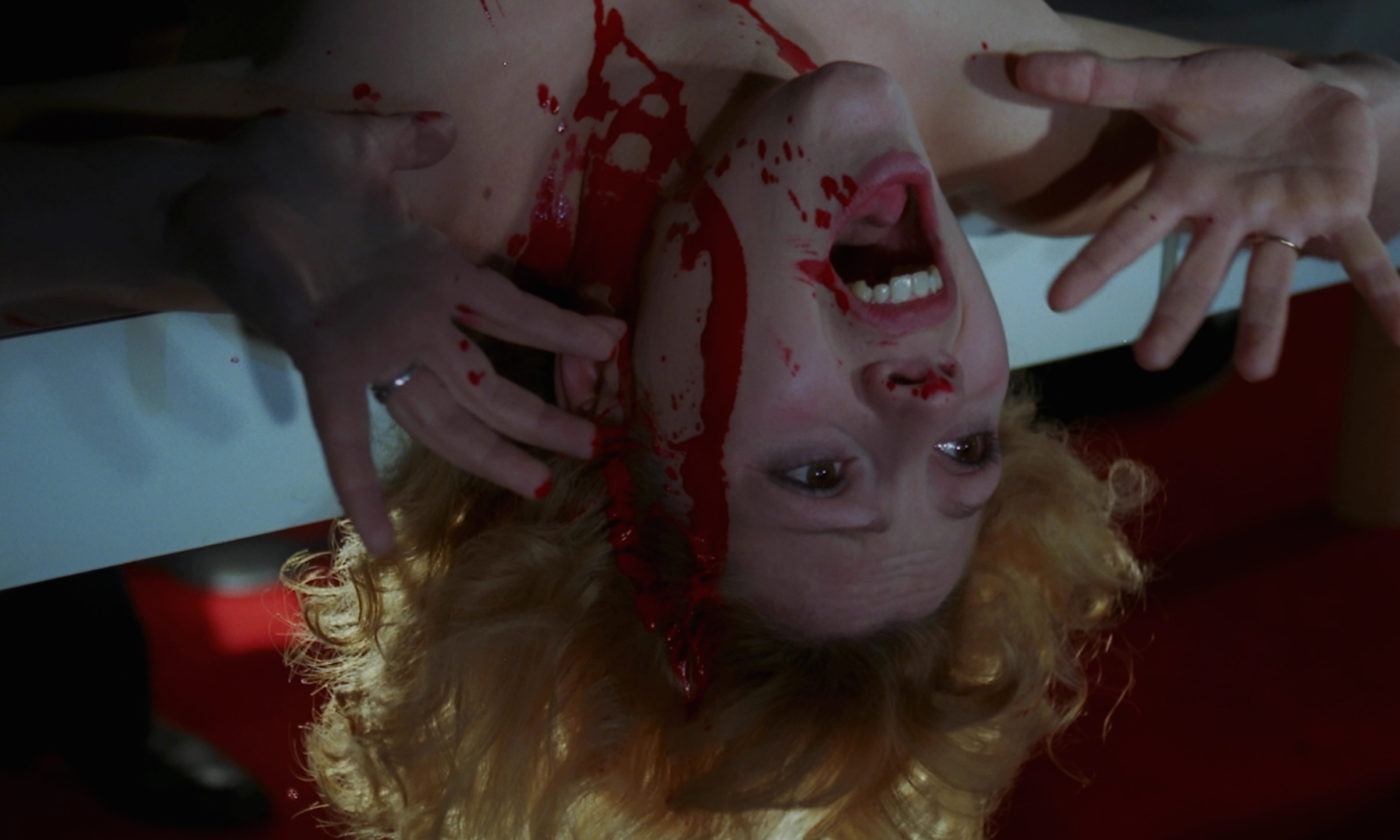
Unable to fend for themselves, the inmates of the skyscraper often feel infantalised, childlike. This creates disturbing complexities whenever sexuality enters the equation, either their intimacy-centric preoccupation with sensation, or when Joe Pantaliano lookalike Alain (Cyril Val) rapes and abuses an unsuspecting woman who has no context through which to view him with suspicion. The woman’s ordeal is violently interrupted by a male inmate who passively murders Alain, closing the loop on a sequence of intense and explicit violence that is typified by its cruel banality. It is in this clinically disturbing sequence that Rollin makes perhaps his most overt (and ill-fitting) cinematic reference, openly recalling a famously gory image from Dario Argento’s Suspiria.
More commonly the ‘black tower’ scenes bring to mind Cronenberg around the mid ’70s. Shivers or Rabid. Depictions of carnality that are warped by humans compelled into unusual or robotic behaviours. Where Cronenberg was exploring compulsions triggered via new pathogens or parasites, Rollin channels something more disquieting. The Night of the Hunted maps terrains where morality has been simply erased. When the human being is a blank slate, anything becomes permissible. Catherine commits a chillingly casual suicide. Even our supposed heroine Élisabeth murders security guards passively, exhibiting no trouble or remorse and achieving nothing in the process.
Robert’s return to the narrative triggers the third act as he attempts to break Élisabeth free of her captors. Dr. Francis and Solange explain to him that the inhabitants of the ‘black tower’ are infected with an illness that rots the brain; that this is effectively a quarantine, citing an environmental disaster as the cause. In this Rollin almost seems to be anticipating the incident at Chernobyl, still some six years away. The Night of the Hunted reminds us that atomic fears existed well before the world was given renewed proof through images from that fateful meltdown. The film is reconfigured before our eyes into an expression of Cold War dread.
Finally, Rollin takes us and an escaped Élisabeth to a kind of industrial interzone; a trainyard where “infected” have been corralled into carriages for execution. These – the most haunting passages of the film – openly call to mind the atrocities of the Holocaust, and find Rollin reckoning with the horrors of the past just as keenly as he does the anxieties of the future. Bridging the two he constructs a through-line of casual inhumanity. The film becomes positioned as a mid-point on a timeline of repetitive callous behaviour rendering the entirety of humanity amnesiac. The patients of the ‘black tower’ are nothing compared to our unending ability to commit genocide over and over again, not learning from the past, or choosing to not remember or engage with the human cost. Dr. Francis is challenged explicitly on this. His answer is a non-answer.
To me The Night of the Hunted is one of the most effective horror films ever made. An eerie reflection on passivity and the erasure of identity. Ironically, it ends on one of the most memorable notes in the pantheon of horror cinema. Hyperbole? I’ll let you decide. Having escaped her seemingly inevitable extermination, Élisabeth is reunited with Robert, who has been shot in the hand and the head, but limps on. Lahaie’s somnambulist traipses doggedly forward, walking on instinct, following a deeply symbolic path down some overgrown railway tracks back toward nature, innocent and emptied. Eve returning to the garden. Adam (Robert), perhaps braindead from a bullet to the head, her zombie husband. They stagger away from camera, a new breed of humans for a pessimistic future, inexorably tragic – like the slow disintegration of the mind – and fit for a world rendered featureless. Our paved paradise.
 The Lost Highway Hotel
1 thought on “Why I Love… #167: The Night of the Hunted”