
Director: Rodrigo Moreno
Stars: Daniel Elías, Esteban Bigliardi, Margarita Molfino
It may be modest by the standards of popular box office, but Argentina is having a modest resurgence in art house circles at the moment, with a handful of notable pick-ups making it to our shores. Over the Christmas break – and unable to travel to the one cinema showing it 200+ miles away – I spent an entire afternoon at home with Trenque Lauquen on Curzon Home Cinema (now also available on MUBI). A sprawling, imaginative shaggy-dog story of a missing persons film, over two parts and four hours, it had the feel of Jacques Rivette’s experiments with longform – possibly improvised – storytelling. Land a good hook and let the characters and narrative go for a walk (literally in some cases).
The Delinquents feels cut from the same cloth and even shares a couple of cast members in the peripheries, suggestive of a burgeoning new wave of likeminded creatives. We begin in the city, with disaffected banker Morán (Daniel Elías) interrupting the daily grind by casually using an open opportunity to steal over $600,000. Calculating that his haul accounts for a lifetime’s salary for himself and an accomplice, he effectively drops it at the feet of unsuspecting colleague Román (Esteban Bigliardi) with a screwy proposition; he’ll confess to the crime and do the three and a half years jailtime if Román will hide the money. Then they’ll split it and never do a day’s work again.
Galling for his arbitrary belief that this relative stranger won’t completely fuck him over, Morán flees for the countryside, and it is here that The Delinquents starts both stretching out and coyly collecting secrets. Just as the film splits into two parts, so the narrative halves between these two men. The haphazard ineptitude of their gambit has the feel of a Coen Brothers yarn, and director Rodrigo Moreno makes it feel as though his movie is going to explore the comedic schadenfreude of their scheme unravelling, but instead it slowly abandons the caper aspect of the story for a slower, richer, irony-laced exploration of character.
If part one is all business, part two – as with Trenque Lauquen – takes what’s been established and wanders off track into territories new. In this case, it becomes far more romantic, even lustful with the introduction of a major new character, Norma (Margarita Molfino), and a more relaxed urge to indulge in some narrative ambling. This becomes a mixed blessing when absorbing The Delinquents in one sitting. The creative sojourn is, in itself, freeing and refreshing. Tick. But, these same adventures are leisurely, and two+ hours into the experience can test patience, especially for those expecting a conventional resolution.
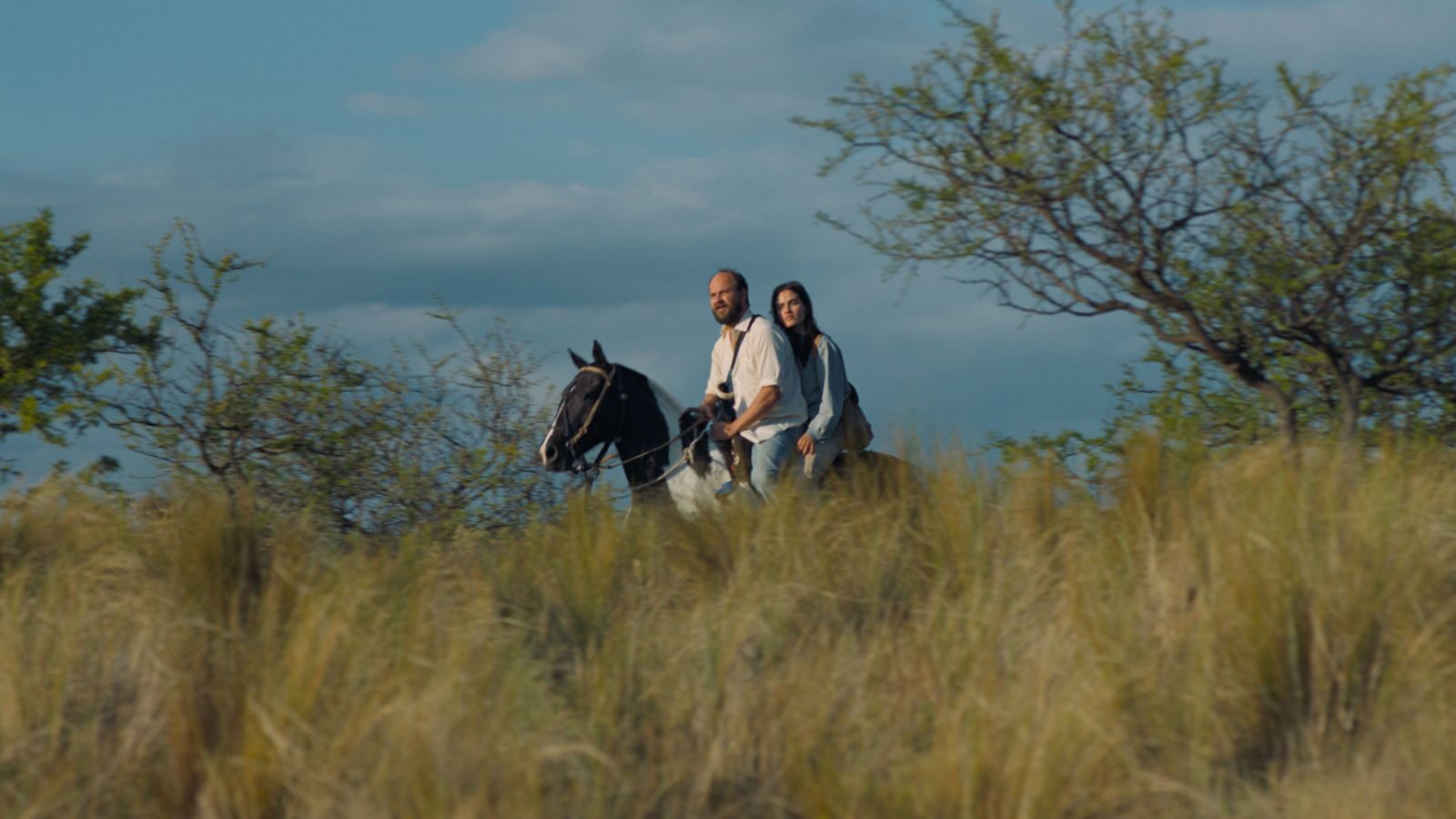
Anyone who caught MUBI’s other recent Argentinian release The Settlers may have already been wooed by the country’s rolling hills amid a litany of violence. The Delinquents takes these same verdant landscapes and romanticises them. There’s a pointed sense – from Morán especially – that rural living represents the apex of freedom from the oppressive strictures of his humdrum, urban life. The earthen scrabble and difficulty of it appeals to him. He finds it exotic.
While we belatedly learn of a physical intimacy stumbled upon during his first flees to the region, his primary love affair throughout the two parts is with the countryside’s space and freedom (making his self-imposed and difficult prison stint all the more sacrificial). One gets the sense that the locals are under the same incandescent spell. Norma and her sister Morna (Cecilia Rainero) are involved in a years-long grassroots documentary project on the topic of the area’s flora. So here the very land is representative of certain ideals and wishes, quite aside from the abstract fantasies kindled by Morán’s stash of money.
A playful sense of doubling occurs all over The Delinquents. From the reflective names of the characters, to one actor pulling double-duty in two thematically links locales, to a playful bit of business at the top of the picture at the bank, where a customer seems to inexplicably have the same signature as another account holder. Moreno employs spit-screen on occasion, and with some enjoyably choreographed timing. The story also hinges on a wild coincidence – itself a kind of doubling – that engenders a sense of neatness that The Delinquents otherwise tends to mosey away from.
There are sporadic joys here almost unmatched at the cinema this year. Little moments of wonder that made the long, long journey worth it (there’s a gorgeous slow cross-fade in the second half where two characters become the size of a bottle that I’ll forever cherish having seen). Flourishes that excuse some of the more testing and indulgent passages. The end of the film, too, may disappoint and annoy, adhering to a novelistic sense of character resolution as opposed to the tighter plotting expected of narrative cinema. Weighing up whether the sprawl was worth it will come down to how much time the film occupies in your mind in the aftermath.
I was frustrated by the second half of Trenque Lauquen during the watching. But when Radiance announced their blu-ray release of the film in the UK (end of May folks), I put a pre-order in immediately. It’s grown in my mind since. Its avenues of interest have become paths I’ve journeyed outside of its hefty running time. The Delinquents may well do the same, becoming a film I experience long after leaving the cinema.

 The Lost Highway Hotel