
Director: Michael Mohan
Stars: Benedetta Pocaroli, Álvaro Morte, Sydney Sweeney
American horror’s ongoing obsession with Italian Catholicism continues apace with the arrival of Immaculate, another quixotic/cacophonous mix of jarring tonal shifts set among draughty stone corridors and populated by dodgy priests and the sinisterly wimpled. The recent spate of these pictures has yet to produce anything as perpetually spicy as Paul Verhoeven’s nunsploitation career-best (and that’s saying something) Benedetta, instead running from the enjoyably camp (The Pope’s Exorcist) to the simply tiresome (The Nun II, Prey for the Devil). Can Michael Mohan’s picture raise the bar?
It’s been a long time coming. Now a fully fledged star, Sydney Sweeney auditioned for Immaculate some ten years ago during one of its earlier iterations that never came to fruition. With luck and good work on her side, she’s shepherded the project into being via her Fifty-Fifty Films production company and taken the lead role. It’s a testament to her commitment and business acumen. Much as social media seems keen to reduce Sweeney to her most obvious attributes, the dedication in her work continues to impress, and Immaculate re-affirms an affinity for horror that shone through in 2020’s hidden streaming gem Nocturne. It’s just a shame that work to polish the script doesn’t appear to have occurred in the intervening years.
As one striking set of promotional posters managed to tip, Immaculate is very much a (more) religious riff on Rosemary’s Baby. Sweeney plays Sister Cecilia, a Michigan native who ups sticks to rural Italy to take her vows and join Our Lady of Sorrows, headhunted (for want of a better term) by the institution’s top brass; Dora Romano’s doting Mother Superior and the crazily smouldering Father Sal Tedeschi (Álvaro Morte). The arrival of a pretty young American girl ruffles feathers, but the rapid discovery of her seemingly-miraculous immaculate conception is the cause of much exaltation… but Cecilia herself is merely overwhelmed.
So too might the audience be, as Immaculate risks creating viewer whiplash with the speed it sets this in motion. There’s nothing wrong with that per se. Indeed, it’s welcome to find B-scale pictures like this one and Drive-Away Dolls gunning it through cinemas at the moment. But there’s a sense, in this case, that some level of atmosphere or intrigue has been hurried out of the room. It’s all very familiar, and not very gripping.
With that in mind such speediness might be this movie’s saving grace, breezing us through an underwhelming opening act. A bunch of nuns sporting red socks over their faces aren’t nearly as chilling as they’re evidently intended to be, and Immaculate has a habit of squandering its most effective shocks. It lifts too many scare tactics from the Conjuring playbook, and quickly comes to feel as much of an also-ran as its aforementioned sister films.
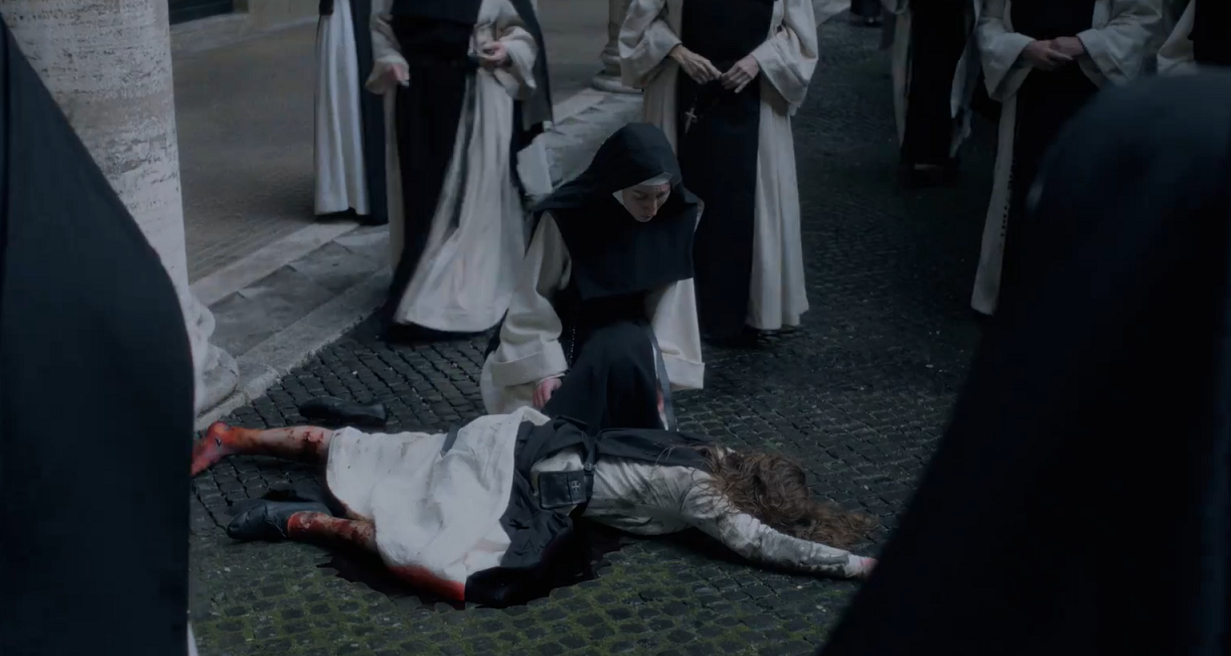
There is good news for the faithful, however. For one thing, Mohan and his music supervisors seem to know their Italian horror history, and they crib lovingly from the country’s ’70s giallo and nunsploitation cycles. This viewer was never more elated than when an early montage sequence arrived set to Bruno Nicolai’s wondrous theme from The Red Queen Kills Seven Times (a personal favourite!). Elsewhere, Mohan and Sweeney (who last collaborated on enjoyable erotic thriller The Voyeurs) don’t shy away from the titillating lineage of so many Euro-sleaze naughty nun pictures. There’s nothing as blatant or gaudy as you’ll find in Jesús Franco or Walerian Borowczyk – it’s a relatively chaste modern variation – but the sentiment is there all the same.
As things progress at a rate of knots, Mohan spends less of his time trying to make this thing semi-serious. Come the third act, all bets are off and we’re tumbling through catacombs in a pleasingly deranged manner. Sweeney’s yelling “what the fuck” and hitting people left, right and centre with anything that comes to hand, and Immaculate grows more confident in the sphere of the morbidly doolally. It’s a step up from the faltering furrowed brow that typified the first half.
Last but by no means least, the film has Sweeney at it’s centre. Between the aforementioned Nocturne and last year’s underseen, underappreciated political thriller Reality, she’s proven herself a capable performer. If Immaculate doesn’t quite outshine either of these career highs, it at least shows the pluck and gumption to try. It will likely best be remembered for it’s final scene, in which Sweeney bids to secure her place in the Scream Queen pantheon, shrieking her lungs out with an intensity that’s equal parts Sheryl Lee and Caroline Williams. What’s actually happening during this scene is sort of revelatory for mainstream American cinema.
It is the boldness and brazenness of these late flourishes that save Immaculate from forgettable obscurity. It plays far better as a skewed rape-revenge picture outraged at bypassed consent than it does as another sermon on the hypocrisy of the misogynistic Catholic church, though one might argue entwining the two is entirely the point. One ultimately wishes that the bones of the material were a little sharper throughout, and that it didn’t need to be carried by Sweeney’s decade-long commitment to the part.
There’s enough here to praise, but it’s quite far from a religious experience.

 The Lost Highway Hotel
5 thoughts on “Review: Immaculate”