
Year: 1950
Director: Roberto Rossellini
Stars: Ingrid Bergman, Mario Vitale, Renzo Cesana
Eruption is a constant watchword in Roberto Rossellini’s roiling convergence of Italian neo realism and tempestuous melodrama, Stromboli. Emotions percolate, forever threatening to overboil as tensions of tradition and modernity play out on the titular crag of rock; a remote and craggy fishing community in the shadow of a volcano.
Enhancing the film’s central conceit of a stranger in a strange land, Robert Rossellini brings Ingrid Bergman from Hollywood to stand as ‘other’ to his array of equally-craggy locals. Bergman – in her first collaboration with Rossellini – plays Karin, a Lithuanian prisoner of war whom we meet in a camp awaiting a decision on her preferred immigration to Argentina. Passing the time, she has struck upon an idealised romance with Antonio (Mario Vitale), a serviceman whom she rendezvous with through the barbed wire fence at the border of the camp.
It’s galling now – in the 21st century – to see a woman choosing whether to accept the advances of a man openly threatening a life of domestic violence as Antonio does in these early scenes. That Karin is willing to accept it speaks to the normalisation of such disparity and mistreatment in matrimony at that time. It also underscores an unspoken desperation in her options under the circumstances. When Karin’s petition is turned down, she accepts Antonio’s proposal of marriage, and returns with him to Stromboli, where all notions of fantasy or romance are immediately dashed.
The island is all-but-deserted save for those who can’t afford to up and leave. Appalled by the poverty and the grim reality of Antonio’s hovel-like abode, Karin makes the best of her new surroundings but with a heart that’s been gutted. Efforts to style out the place with creative flourishes are met with consternation by the local women who judge her harshly, and Stromboli quickly asserts a number of culture-clash enquiries while rending our hearts with Karin’s contained feminist fury.

Bergman’s Karin is an avatar for modernity, and her dissatisfaction with her lot plays as a reflection of a generation of women who came through the war more independent than their mothers, emboldened with expectations for a world that seemed to want to shrink back to the old ways and simply forget. Karin’s collision with the cultural void of Stromboli couldn’t illustrate that volatile tension more clearly. She dares to want more from her life. And while she respects and loves Antonio to a point, Bergman plays out her regret in a manner that suggests the resplendent works of Douglas Sirk that were due to flourish in America in the coming years. Stromboli beats Sirk (whom I adore) to the punch, albeit via an austere palette of stark monochrome.
Karin is evidently intended to represent progressive values. She abhors Antonio’s enjoyment over two rabbits forced to fight (a scene that plays quite disturbingly today), while her dress eschews the prim modesty of the other island women. Positively conservative by today’s standards, her tied blouse while frolicking in the rock pools with the local children is almost indecent by the standards that surround her. She appears relaxed, youthful and sexy. The local women look on disapprovingly, peeping over cobbled walls like the weirdos from The Wicker Man. Stromboli predates the classic British folk horror flick by over 20 years, but it feels like a probable influence and precursor. Rossellini’s film is never labelled a horror movie, but the vibe is most certainly there in the naked hostility of eyes both visible and unseen.
Class plays a part, a significant one. Karin admits to the island’s priest (Renzo Cesana) that she comes from a comfortable, maybe even wealthy family, but that these luxuries are now lost. In this same conversation she makes sexual advances to the priest – out of desperation, out of dissatisfaction with her lot – an urgent reaction that is among the film’s first quiet eruptions, and the threat of more volatile spills to come.

Moving into an extended second phase that uses nature to express Karin’s tumult, Stromboli departs from the melodrama of the rock for a documentary-style study in the tuna fishing that makes up the livelihood of the locals. Set against Karin’s ultimatum to Antonio that he needs to change, the picture diverts to a kind of social realist action spectacle. Singing sea shanties as they hoist their nets, Rossellini takes in the toil and camaraderie of the fishermen in a manner that shows a respect that other aspects of the film – particularly Karin’s point of view – often dismisses. It helps balance the picture immeasurably. Then the thrashing tuna rise to the surface and Stromboli erupts forcefully for the first time, exposing the power of nature and the violence of man. In modern cinematic terms it recalls both the dark trauma of trawler documentary Leviathan and the powerful seaborn sequence at the centre of Albert Serra’s recent Pacifiction.
The picture doesn’t rest in the aftermath. Rossellini cuts from these extraordinary scenes to Karin’s terror as the volcano that looms over her home sputters angrily into life, showering the village with ash and debris. Suddenly we’re in the midst of a fully-fledged disaster picture. The things we’ve learned of ancient eruptions like Pompeii are inevitably brought to the forefront of our recollection as Rossellini switches from swiftly and convincingly staged action to documentary footage and back again. His pervasive neo-realist instincts elsewhere in the picture – and in the immediately-preceding sequence – assist here no end. For a 1950 production, Stromboli’s natural disaster is more convincing than most modern CG spectacles. It is tight, fast and merciless, even as the townsfolk all escape briskly.
This upset in the narrative briefly appears to swallow Karin’s subjective arc of dismay, and threatens to cast it as trivial in comparison. But perhaps instead – like those trashing tuna – it is an expression of her inner turmoil. A manifestation in nature of an inner volatility and anguish. And a catalyst for change. For transformation.
In the aftermath of the eruption Karin is resolute; she must leave. “I’m not afraid to take risks as long as I’m free to fight for myself” she says, and it feels like a manifesto for the film at large. The emergence of her determination. Leaving Antonio will leave Karin with even less than her meagre lot on Stromboli. She will be penniless, destitute. But to Karin this is preferable to the threats to her safety and sanity that exist in torpor and inaction. Antonio promptly nails the door shut, locking her up like Rapunzel. Karin escapes swiftly by calling on the assistance of the hunky lighthouse keeper (Mario Sponzo) with whom she had a perceptible flirtation on the journey to the island. Karin exercises her feminine wiles in his company. She is more demure and suggestive. She uses her sexuality to illicit from the lighthouse keeper the means to escape the island.
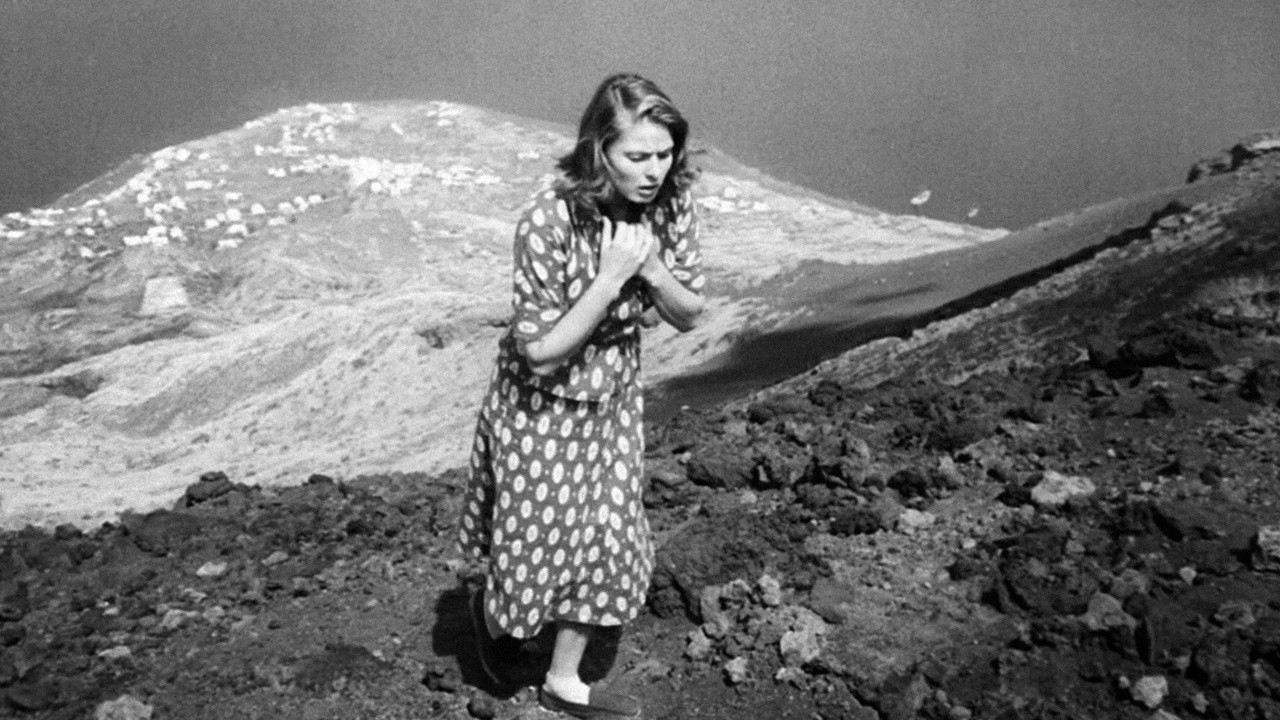
Crossing to finally leave, she becomes lost and suffocated by the roiling clouds from the volcano that cause her to choke and become disorientated. The film’s promise of her emancipation falters toward vertiginous tragedy and despair. The score grows bombastic as Karin stumbles on, directionless, refusing to admit defeat. She finds herself at the epicentre of the island; the crater of the volcano. Overwhelmed and distraught she accepts the idea of being literally consumed by Stomboli. There is an acceptance of mortality here; even choosing suicide is strangely empowered as a rejection of Antonio’s feeble domesticity. But Karin is not forsaken. She survives the night and resolves to continue on, rallying at God as she clutches her belly and unborn child; the future.
This sequence is as emotive as it is strange. It feels like Rossellini and Bergman are choosing the death of the film that came before it. It is almost like a pan away from the rest of the action. A wandering off. Off from the dramas of the village, from the world of men and the stresses of civilisation. Almost a prefiguring of Michelangelo Antonioni’s dislocated string of movies that opened the 1960s. And it would be as such but for Karin – and Bergman’s gigantic performance – which centralises a human figure in anguish. At the end of her tether but still resolute to go on, we’re left knowing that Karin will do just that, and even at the precipice of defeat she remains heroic.
 The Lost Highway Hotel