

Director: Kaouther Ben Hania
Documentary cinema has always brought with it a particular tension that narrative cinema (largely) escapes when it comes to veracity. Everything is editorialised. Cut and stymied to present – consciously or not – a point of view. The very position of a camera is selective. Even in the most rigorous of cases, the question of ‘truth’ exists in documentary in spectral form.
A number of filmmakers have acknowledgement the artform’s capacity for contradiction in this way (indeed, isn’t the mockumentary a playful parody of this same tension?), and leaned into the blurred lines. Abbas Kiarostami with Close-Up, for example. Or – as Four Daughters constantly reminded me – Samira Makhmalbaf with The Apple.
Four Daughters raises these ideas and questions thanks to the nature of its construction. It invites a Tunisian mother, Olfa Hamrouni, and her two youngest daughters Eya and Tayssir Chikhaoui to tell their story. It obfuscates what that story is, exactly, promising only that it will explain or at least reveal what happened to ‘missing’ sisters Ghofrane and Rahma. That’s the tease. What makes it unique (or semi-unique) is that actors will fill in for those who can’t be present for director Kaouther Ben Hania’s reconstructions. Olfa, Eya and Tayssir will play themselves.
Why these women are telling this story – and how they have some level of notoriety in their native Tunisia – is something you either know or you don’t walking into the film. I didn’t. Ben Hania’s piecemeal construction of her film assumes that a wider, global audience will be similarly ignorant of the details. Filled with acted scenes intercut with more straight-forward talking heads moments (many of which feel nakedly confessional), Four Daughters plays out to the beats of a narrative film, inviting us to get swept up in the story. Part of that contract is withholding information. Taken in this mode, it reaches out to titles like The Virgin Suicides, Girlhood or Mustang in its recollections of adolescence and sisterhood. As an act of feminine autobiography it shares blood with animated excursions like Persepolis or the criminally underseen Colombian offering Virus Tropical.
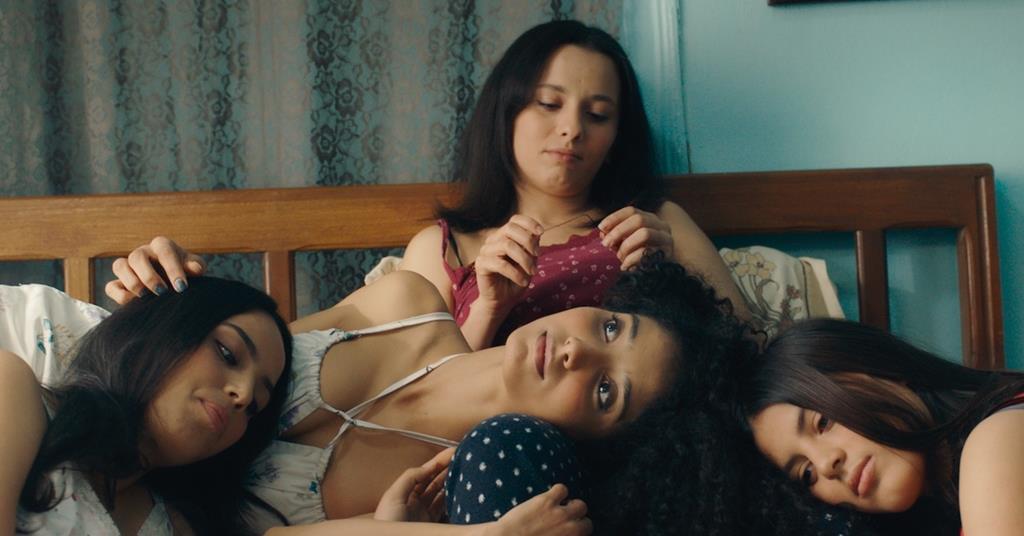
The ‘real’ sisters quickly bond with the women playing their substitute siblings, and a scene of the four of them sprawled out on a bed laughing together could spring from any number of sorority-focused ‘narrative’ pictures including those itemised above. But the sobering truth (that word again) of the matter is always right there.
In a heated moment caught between takes of one reconstructed memory, Eya assures that she has emotional detachment, that the events being covered in Four Daughters have already been addressed for her in numerous therapy sessions. The statement suggests she believes she’s out the other side of it.
The remainder of the film presents a slightly different assessment. Ben Hania’s use of actors to fill the negative spaces in her heightened, melodramatic reconstruction ultimately works to soften or protect the real women in the film. When things get too raw for Olfa, for example, she is switched out with another actor – Hand Sabry – further diluting the authenticity of the recreated memory, but shielding the real Olfa from further harm. It doubles the meaning of what’s being seen, splitting an act of exploitation into an act of kindness. It’s a cushioning that separates Four Daughters slightly from Makhmalbaf’s The Apple – which asked all participants in a case of child endangerment to recreate the event – but both films seek to explore how reenacting scarring events might prove therapeutic. The women’s tears mostly scan as cathartic. Occasionally, through the speculations encouraged by that aforementioned tension, maybe even performative.
It’s tough to talk about the meat of the film without ‘spoiling’ Ben Hania’s revelations, and I’m going to have to at least tip it a little bit here. Substantively, Four Daughters presents two vying sea changes in Tunisian culture; the impact of looser, Western ideals in its women (fashion, sexuality, bodily autonomy, independence) and the insurgence of extremist Islamic factions into the country’s post-revolution vacuum. One gets the sense of a country being jostled from both sides. In the searching eyes of Eya and Tayssir one frequently reads a conflict between these ideologies. Pressure is put on their generation to forge a new way forward for women in Tunisia. The binary options afforded divert harshly from the conservatism of the nation’s past generations. One into a liberalism learned from European and American media, the other tugging toward a more constrictive, misogynistic form of dominance and control under the guise of piety and moral rectitude.
Ben Hania briefly intercuts her intimately staged dramas with TV news footage from the passing years to provide just enough context for the wider societal struggles happening around these women, but it feels exceedingly selective. A crack in a closed curtain. A sliver of information. Questions remain for the audience. The same ones that ultimately remain for Olfa, Eya and Tayssir, particularly around the stranglehold of religious fanaticism and just how it secures a foothold. Four Daughters points toward events in the family history that might prove antecedents for the choices made by Ghofrane and Rahma (ranging from abuse to domestic violence), but the power of the external voices manipulating their path remains mercurial and intangible. The urge to rebel being capitalised upon is one thing. But is it the only thing? The question of how radicalisation happens in the present slips through our understanding once more.
As an outsider looking in, Four Daughters is a fascinating watch. Olfa – the real Olfa – is a stout set of contradictions. Powerful but broken. Cruel but loving. Eya and Tayssir, meanwhile, are disarmingly charismatic and articulate in front of the camera, and blend so well with the women playing their absent sisters (Ichraq Matar and Nour Karoui; both terrific). It all makes for a compelling journey.
Notions of truth and objectivity abound given the very nature of Ben Hania’s film, but its a bold and ambitious attempt to encompass many sides of an issue while remaining acutely personal to those involved. Through this the human toll is always at its epicentre. It may be reached through play, it may nestle on the uneven surface of memory, but for Olfa, Eya and Tayssir, this is their truth.

 The Lost Highway Hotel
1 thought on “Review: Four Daughters”