
Director: Andrew Haigh
Stars: Jamie Bell, Andrew Scott, Paul Mescal
There’s a little bit of mildly awkward, mumblesome, vaguely pretentious dialogue at the beginning of Andrew Haigh’s ghostly gay romance All of Us Strangers. Nothing too damning or uncomfortable, but a couple of lines that ring slightly offkey, and then – for two-thirds of its remaining running time – it does a decent impression of being a perfect picture.
I’m not kidding. As the initial frost thaws, something truly remarkable starts taking form in front of you. Appearing like a smudge in the fog slowly asserting its own definition. And it feels like a gift. It’s generous. It’s multi-layered. And it feels subtle in all the right ways without seeming precious. Because of the layers. Because of the complexity. Caught in the halo of what sometimes feels like an endless sunset, Haigh’s film dares you to think it might be the year’s best (whatever that means). But, like the most affecting of romances, it doesn’t quite last…
Adam (Andrew Scott) seems to have recently moved into a lonesome London high rise where he is embarking on a new writing project about his long-dead parents (killed in a car accident when he was 11; Haigh has the commendable presence of mind to comment on the unoriginality of this). Disturbed by a malfunctioning fire alarm, he meets Harry (Paul Mescal), who immediately registers a sexual potentiality between them. Adam is shy and reserved, not used to the attention of others. He’s sort of adorable that way. While this uncertain new connection presents itself, he regresses to the past, visiting the suburbs of his childhood where he has a seemingly magical reunion.
Adam is able to commune with his dead parents (Claire Foy, Jamie Bell), sit with them in their old home, bring them up to speed on his life. Scott plays this sweetly, tipping toward man-baby as long-dormant familial roles assert themselves, but without going full Joaquin Phoenix. Foy and Bell dance their way elegantly through these interactions, and Haigh uses these meetings to beautifully sketch out old and new dynamics, observe British middle class mannerisms acutely, and reflect on the cultural shift in attitudes that have occurred (or haven’t) over the past 40 years.
While watching one is moved to ask the ramifications of what’s happening here. For anyone who has lost a parent or really anyone close and dear, this is raw, truthful and articulate material. Take it as Adam having extended conversations with himself, and the people he meets are his projections. Coming out to his mother is rendered heart-breaking, in part for her dated assumptions and distaste, but also because Adam might be the one arranging her to feel that way, predicting her rebuttals. Haigh uses All of Us Strangers to show us these impossible exchanges we all have with those we can’t. There’s not a moment that’s overblown. These scenes are wonderful.
Elsewhere, the technical craft of All of Us Strangers will make you swoon. A key sex scene challenges last year’s Passages for the candidness of how sex between two men can be shown to us. Passionate, gruff, Denis-esque in its study of muscle and movement. Haigh’s rarely been this nimble, aided by the exemplary impressionistic camerawork of Jamie D. Ramsay. All reflections and liquidy movements, the film reaches an apex of expertise during a halcyon montage of Adam and Harry’s flourishing relationship as it leaves the high rise for the throbbing nightlife of the city. Set to a remix of Blur’s “Death of a Party”, it manages to capture Adam’s crossroads. He’s the older man but also the child. At home, and with Harry.
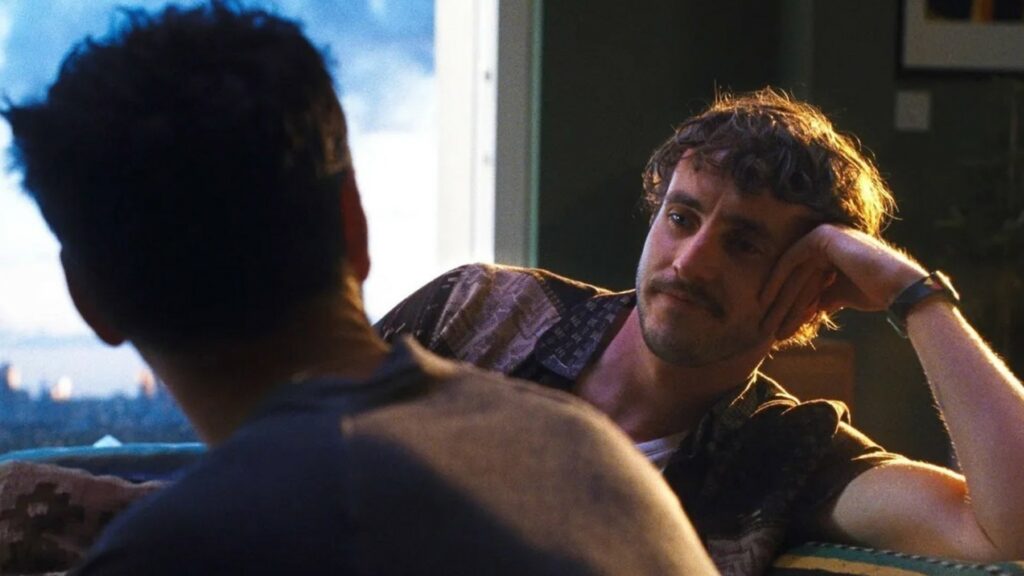
And then something rogue enters the alchemy. I don’t want to say too much, but when Adam tries to mix his two very separate worlds, the tonal tightrope that Haigh’s been walking slips. We dip – quite prominently – toward the gravitational abyss of sentimentality. Teary goodbye scenes stack up. The material gets syrupy. And those smudges that have been so beautifully unclear coalesce into hard shapes.
Now, this is my reaction to the material. Nakedly subjective as opposed to critically distanced and astute. But it feels like Haigh gives away the subdued magic of what he’s created for something altogether more manipulative and ‘crowd-pleasing’. In the process a lot is lost (not least in the mawkish final moments that feel like a greetings card platitude).
Adam’s overwrought goodbyes to his parents take the wish fulfilment of the body of the picture to new extremes. It is touching, but its drawn-out, heavy-handed and also very convenient. One comes back to wondering about these versions of Adam’s parents and their real nature, and how that reflects on the mental stability of our fragile protagonist. Haigh seems intent on fixing the nature of Adam’s world. Inking in borders that were more powerful as sketches.
What occurs after only compounds this, and leaves us with something very sweet but frustratingly tragic. All of Us Strangers – against its best intentions I’m sure – can feel like another for the stack of queer romances doomed to heartache. And not only heartache this time, but a more pronounced and troubling psychological purgatory. The ending here felt incredibly cruel to me. Perhaps Haigh wanted to counter a sense of utopianism about the modern day gay experience. That’s got merit and pragmatism. But his choice feels locked in a cycle of queer cinema where happiness isn’t allowed. All of Us Strangers suffers from the same balled-up heart owned by Adam.
I’m doing the worst thing in modern film criticism and I know it. Bemoaning a work of art for not being what I wanted it to be, instead of what it is. Except I went in with no preconceptions (I’d deliberately kept myself in the dark on this one) and I meant it when I said the first two-thirds of All of Us Strangers felt – thrillingly – like a perfect film. Subtle. Watery. Beautifully written and played. Technically gorgeous. There’s too much greatness here not to recommend it. Flock to it, please.
But be prepared to possibly wrestle with the outcomes. I’ll continue to do so.

 The Lost Highway Hotel