

Director: Hayao Miyazaki
English Language Voice Stars: Luca Padovan, Robert Pattinson, Gemma Chan
How do you follow such an elegant, definitive closing statement like The Wind Rises? A film so nakedly personal, perfect and in conversation with all your prior works? This question was among the most boggling before going to see Hayao Miyazaki’s phoenix-like twelfth feature The Boy and the Heron (original, better title How Do You Live?). That it half-remains after is a testament to the overwhelming nature of this spiral of creativity. In a real sense The Boy and the Heron is as all-encompassing and reflective a ‘final’ picture as The Wind Rises. It’s less literal in its autobiography, instead unfurling like a dream of an entire life’s work. This one feels like a deep-dive into the very psyche of its irrepressible creator. There are a lot of birds.
We begin, of course, at the end of WW2 and the devastation wrought on Japan as young Mahito (US voice Luca Padovan) rushes through a city aflame to find his mother, but he is too late. Two years later and he and his father Shoichi (Christian Bale) have moved to the country, where a replacement mother – and a younger brother – are in the offering. The rural homestead has a sense of rich and mysterious history and is guarded, it seems, by a heron (Robert Pattinson) with a preoccupation for Mahito. When mother-to-be Natsuko (Gemma Chan) goes missing, wandering into the forest, Mahito fears the meddling of the sinister heron and chases after her with elderly Kiriko in tow.
While Miyazaki makes these opening moves gently, once the ground gives way beneath your feet, The Boy and the Heron quickly tumbles into fantasia with few handholds to stymie the descent. His most celebrated pieces have worked in this way. Spirited Away, for instance, works to its own mercurial logic. The viewer, then, is encouraged to submit to the film’s free-flowing dream odyssey. Mahito discovers a tower of some significant power, commanded outside of time and space by his Great Uncle (Mark Hamill), a hub or nexus for converging realities, real and imagined. His quest is pure fairy tale (rescue the sleeping princess; in this case Natsuko), his journey is pure Miyazaki.
So many motifs and preoccupations of the great master reveal themselves, mingled together here in a magical poultice. Aviation, of course, is a touchstone. Not just from all the herons, pelicans and parakeets, but in the off-hand reveal that Shoichi’s work involves the manufacture to fuselages. Adolescence – coming of age – is a struggle so seismic that it can end worlds and create new ones. Gaggles of small imagined creatures – Miyazaki’s ever present Little Guys – delight and horrify depending on their multiplicity and urgency. The cutest here are pre-souls travelling to our world, furthering a sense that the subconscious is a kind of raw origin place.
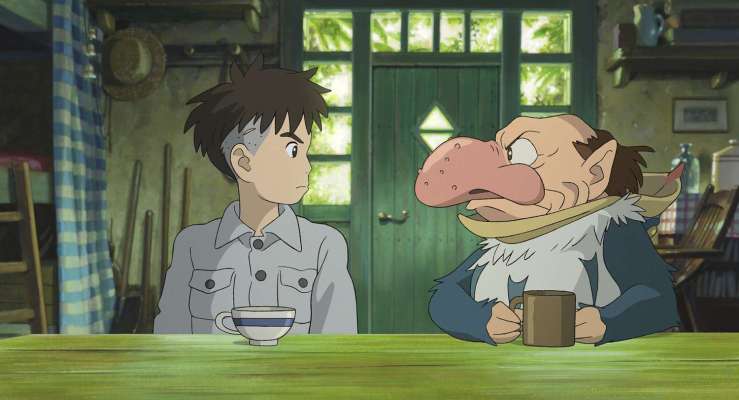
Thinking of Mahito’s odyssey as a wade through the primordial soup seems quite fitting, actually, as once it gets lost in its interior logic, The Boy and the Heron feels like a hotline direct to Miyazaki’s source of inspiration. Soft corridors crackle with electricity like fissures in the brain while everything from genus to personality becomes malleable and porous. The heron is just a suit for a dumpy, red nosed pixie person, both horrible and ridiculous… but it is also a heron. Elsewhere, Mahito’s parallel mothers and poor old Kiriko are reborn, recast, remoulded, giving the impression of an amorphous matriarch who is, can be or has been any and all women. I’ll reiterate, trying to apply rationality to The Boy and the Heron will only get you frustrated. Few motion pictures so vividly conjure the sense of submitting to the machinations of a dream. Bi Gan’s Long Day’s Journey into Night was the last to evoke it so.
Because of this sustained sense of falling – falling into the abyss of one man’s imagination (Miyazaki is both Mahito and the Great Uncle in this parable) – The Boy and the Heron may well frustrate if you’re loathe to let go. It’s images are both wildly original and a collage of prior Ghibli highlights melted down and remoulded into new forms. The beautiful, the absurd and the grotesque.
Vividly animated as ever – with a few new fiery tricks up his sleeve that feel like a respectful hat-tip to his former creative partner Isao Takahata – the fluidity of this menagerie is almost too much to take in on a single sitting. This viewer feels awash in it still. That it rejects a coherent narrative form makes it feel slippery, and at this stage in digesting it I wouldn’t go near calling it a ‘favourite’ or ‘best’ (flighty, dangerous words). It’s a daunting film. Large and unruly. Liquidy.
If I’ve made it sound fickle or half-formed I’ve done a disservice. There are times when The Boy and the Heron is incredibly clear. The world of the tower is galvanised by literal building blocks that need to be maintained by a human hand. Nudged, reshaped. Imagination is such a place. It requires our attendance and nurture, otherwise it is toppled (I couldn’t help but wonder, as an aside, how much of the Parakeet King is supposed to represent Goro. Poor Goro).
Time will tell The Boy and the Heron‘s position in the generous canon of work Miyazaki has gifted us. The man is 82 – 83 in the new year – and embarrassed to have announced retirement more than once now, so forgive me for thinking this still might not be his final statement. It is among the least concerned with how it is received. It comes across a little stream-of-consciousness; a communication of emotion and feeling, as opposed to a traditional story or lesson. Animation is anything but improv, but The Boy and the Heron feels just so organic. Someone reaching out to convey a thought or idea that’s ineffable, before it fades away like a dream on waking.
If this review has gotten pretty flowery, that’s a by-product of trying to articulate Miyazaki’s own methodology this time out. This one is all soul.

 The Lost Highway Hotel