

Director: Michael Mann
Stars: Gabriel Leone, Penélope Cruz, Adam Driver
Like Ferrari in 1957, Michael Mann’s movie had the odds stacked against it. It’s been a conspicuously long journey to here from his last offering, 2015’s Blackhat; a film that hardly set the world ablaze. When that glitchy tech thriller was released, the superhero movie was king, and anything requiring more thought was promptly swept to the margins. And then advance word from the festival circuit was middling on Ferrari. A worry, especially considering the fervent following Mann has gathered in certain circles (his name is as unimpeachable to some as Christopher Nolan’s or Denis Villeneuve’s – something that has positioned him as a linchpin of the oft-decried or ridiculed “FilmBro” culture).
But to this viewer’s eyes (and I’ve a less precious view of Mann’s scatty body of work), Ferrari is of a disarmingly high standard, is less inclined to follow the tickbox rules of the biopic than one might have expected, and has landed at almost the perfect moment. Perfect because (finally!) the tide has turned against identikit caped crusaders. The tipping point is here. And that has coincided – close enough – with something called Barbenheimer.
The social media storm whipped up around the simultaneous release of Oppenheimer and Barbie helped both films, and generated one of the most encouraging spikes in cinema attendance of recent years. This artificial event is having a kind of halo effect, as seen in the better-than-anticipated box office for Scorsese’s 3 hour+ Killers of the Flower Moon. Studious or weighty drama is back on the menu boys, and is being met by an eager and curious audience. Suddenly the prestige biopic – once the stuffiest of genres – is back in favour. Remarkably, this has coincided with both awards season – which every year’s crop are held for anyway – and a surprisingly strong uptick in quality and risks taken (not you, Bradley Cooper). The aforementioned Oppenheimer. Ridley Scott’s Napoleon. Sofia Coppola’s Priscilla. And now Ferrari.
Skirting the urge to play out like someone skimmed a Wikipedia page (sorry, Bradley Cooper), Ferrari beds down with the motor company’s CEO Enzo Ferrari at a late turning point in his career. It’s 1957. Over a decade since the war, and longer since the man hung up his racing cap. Surprise death looms in the man’s rear view mirror; from the two friends lost on the same day during a hellish race, to the loss of his only adult son (and would-be heir) Alfredo. At heart still a risk-taking motor sportsman, Ferrari has driven his company to near financial ruin, and the upcoming Mille Miglia – a 1,000 mile endurance race through the Italian countryside – has higher stakes than just who lifts the trophy at Brescia.
Playing out in tandem with this drama is a furore in his personal life that holds a mirror up to his methodologies as an entrepreneur. His hot-tempered, loving wife Laura (Penélope Cruz) is also his business partner. Having partway compartmentalised her husband’s penchant for affairs (she’ll still shoot at him for it), Laura is unaware that – ever since the war – Enzo has maintained another family with mistress Lina Lardi (Shailene Woodley). Their son Piero (Giuseppe Festinese) is coming of age, and Lina is applying pressure for him to be recognised as a Ferrari. This coincides with Laura’s investigations into where portions of the company funds have been funnelled as Enzo eyes a merger with one of the business’ other major players.
Ferrari, then, flits between two modes; high-octane driving spectacle (maybe the finest this side of Tarantino’s secret best film Death Proof) and psychologically pregnant domestic drama. In the latter machinations we see how Enzo treats his family and his company the same. Having built up self-acknowledged walls in the wake of so many losses, Enzo’s fraught bargaining with both Lina and Laura mirrors his tactical play to secure a future for Ferrari. Both are strategic arenas in which success means incrementally gaining ground; something further reflected on the racetrack.
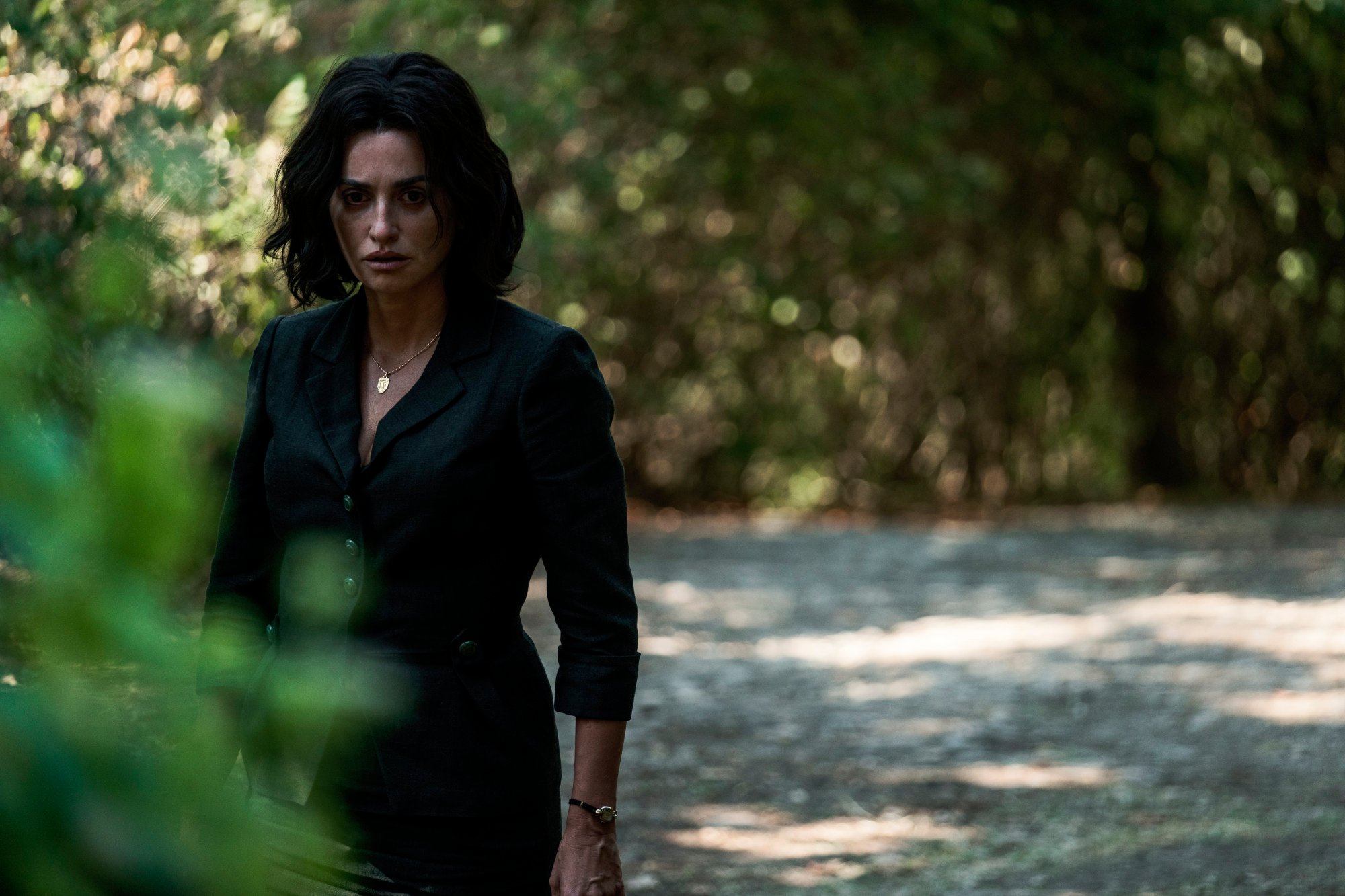
While cinematography, stunt and effects work render the racing sections heart-stopping and occasionally horrific (if you don’t know, don’t Google the 1957 Mille Miglia – even the trailer has not prepared you for Mann’s savage reconstruction), the human drama is propelled by two powerhouse performances. Both Driver and Cruz bring larger than life presence to their respective roles. While both are playing ‘big’, both avoid the pitfalls of awards bait showboating (sorry, Bradley Cooper), instead doing the work to round out two oversized personalities who can’t help but clash together. These are passionate people and sparks will ignite.
Driver’s been down similar roads before, of course, adopting an Italian accent for Ridley Scott’s glossy and camp House of Gucci. He was, by and large, the straight man there. What he does here is more bombastic, but also insular and roiling. His Enzo Ferrari is stubborn and proud, but also vulnerable and haunted, especially when alone. Cruz, for her part, brings humanity and maturity to yet another ‘fiery Mediterranean’ role. Her flashy first scenes bring to mind the renegade spirit of Vicky Cristina Barcelona. But later, when she’s in a more bruised combative mode, the gradations and considerations are clear. She arguably steals the film. Woodley is less sure-footed, from accent through physicality, and its probably a mercy that her stab at a largely thankless character is relegated to the margins.
As one might expect, legacy is of chief concern here, from continuation of the Ferrari brand to continuation of the Ferrari name; ideas that are co-mingled to reflect the sketchy person-hood of corporations in the mid-20th century and beyond, not to mention the politics of patriarchy. It made me reflect on the essence of so-called ‘dad cinema’; once the province of war heroes and cowboys, these movies were often clear and coherent morality tales. Since the middle of the last century, however, our new gods of business have stolen this spotlight, and their merits are often more circumspect. This brand of cinema often (as here) is moved to ask, what have we done, and what were the costs? We’re worried by our heroes now, as opposed to reassured.
As onscreen text assures us come the close, Ferrari were cleared of any culpability in the events that occurred that year at the Mille Miglia (its last year in that form), but Mann’s film colours this with complexity. A key scene in the middle of the story shakes itself to the surface, in which Enzo goads his drivers to indulge their hunger for victory, to go faster, to push harder. What happened was an accident. But did it originate on the road or in the boardroom?
Ferrari is a compelling and welcome surprise, a further example of what can be done to the staid biopic to secure our involvement when the ambition goes beyond Paint by Numbers (sorry, Bradley Cooper), and probably Mann’s best film since The Insider. Its limited theatrical window before landing here on Sky will mostly keep it out of the conversation about the year’s breakout successes (both moderate and exponential), but its every bit as muscular and knotty as most* of its brethren this year.
*Sorry, Bradley Cooper.
 The Lost Highway Hotel