

Director: Takashi Yamazaki
Stars: Ryunosuke Kamiki, Hidetaka Yoshioka, Minami Hamabe
Since first emerging from the depths of the Pacific almost 70 years ago, Godzilla has reigned supreme as one of the world’s most enduring franchises, notching up over 35 films between its many Japanese iterations and the scattering of pale US imitations. There’s much to explore in that success, particularly the psychological aspect of what we find so enduring about watching out cities being levelled by a monster made from our own ecological misdeeds. The reckoning we deserve?
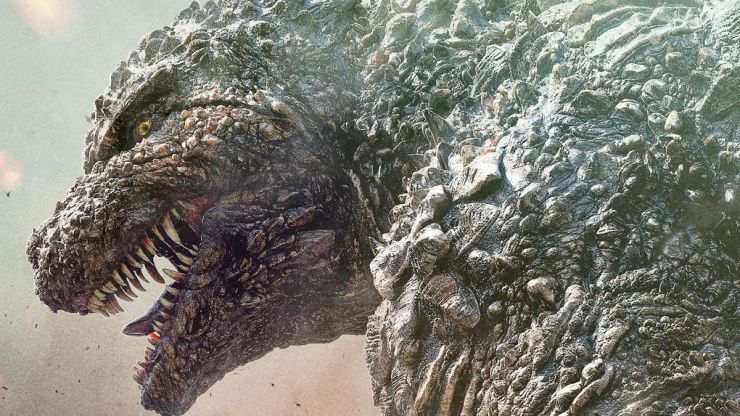
While Adam Wingard and Legendary Pictures pursue an appealing line of enquiry into how outright-dumb these movies could be, mashing our beloved mega-lizard up against King Kong, Japan has been toying with some form of reboot for the series over the past decade. Where 2016’s Shin Godzilla shook off the classic format for something more satirically cutting about government bureaucracies and disaster response, Toho have evidently eyed the upcoming anniversary for something more faithful to the kaiju’s origins. Godzilla Minus One lands somewhere between a reboot and a prequel.
Set between 1945 and 1947, Godzilla Minus One technically predates Ishirô Honda’s very first film, and slightly skews the giant creature’s allegorical muscle. At the film’s opening we meet nervous kamikaze pilot Shikishima (Ryunosuke Kamiki) in the process of shirking his responsibility in the face of a fight that’s all-but-lost already. Landing on Oda Island under the pretext of needing maintenance for his plane, Shikishima witnesses the first strike of Godzilla and freezes up during the onslaught. He awakes as one of the few survivors, and is sent home with a sizeable amount of shame.
Arriving in a devastated Ginza after the war’s end, this handsome outcast builds a makeshift family with a homeless young woman named Noriko (Minami Hamabe) and orphaned baby Akiko (Saki Nakatani). Good work is hard to come by and, still devaluing his life and worth, Shikishima takes a job at sea detonating landmines left behind by the deserting Americans. It is in this capacity that he comes face to face once more with the mighty Godzilla, now bigger, and expanding its territory to include Tokyo…
I’ll say as an aside what an absolute joy it is to see the Toho logo shining out in a multiplex setting with a packed and enthusiastic crowd. Godzilla Minus One arrives buoyed by good word and notable US box office, proving the enduring love for this series. Who says Americans won’t turn up for subtitles?
If the original film decried irresponsible nuclear testing happening at the time and manifested the PTSD of Hiroshima and Nagasaki, Godzilla Minus One broadens the allegory to all of war. The growing beast of this picture feels like the shadow of all those years falling over Japan as it starts the industrious process of reconstruction. The flighty fear that war – and defeat – isn’t done with them. To a degree it carries over Shin Godzilla‘s contempt for the government, particularly via one rousing thread in which a civilian response is both called for and later delivered. But while Godzilla Minus One feels like a pointed Japanese response to the horrors put upon them at the end of WW2 (it’s a sturdy counterpoint to this year’s Oppenheimer), it also embraces a number of western cinematic touchstones that may explain its breakout success.
Director Takashi Yamazaki has done something rather industrious here, setting his sights on the twin pillars of western populist cinema; Steven Spielberg and Christopher Nolan. Spielberg is conjured most keenly in the first half of the picture. Shikishima’s bond to his ocean-bound crew and their rickety wooden boat plays like a loving hat-tip to Jaws. The Amblin man’s presence is also felt in the economic melodrama of the film’s domestic set-up. The warmth and security of the makeshift family at the core of the story is established quickly and with the kind of sincerity that Spielberg often mines so effectively.
The latter part of the film – up to and including its thrilling third act showdown – tilts more toward Nolan. Not only does the finale split between sea and air like a re-enactment of Dunkirk, but Yamazaki makes formal choices that strongly recall the British blockbuster maker. Flexing of time via slow motion. Judicial implementation of sound and silence. An editorial thrum that builds to crescendo. Even the colour grading feels a little Nolanesque.
It’s one thing to emulate the kings of blockbuster movie-making. It’s another to achieve that same sense of wonder and risk. Of the epic and the intimate at the same time. Yamazaki makes such an attempt look effortless here. A lot has been made already of the film’s supposedly small budget – and how good it all looks with this in mind. There’s likely a more probing conversation to be had beneath the surface regarding how well VFX artists are paid and treated. But as breath-taking as the visuals are, those budgetary constraints still occasionally announce themselves.
And that’s okay.
Because Godzilla has always delighted in how it shows its workings. Going through the Showa Era films in Criterion’s gorgeous bookset, one of the enduring charms is the handmade aspect to these movies. The models and sets, the monster suits and miniatures. The magic for Honda was how to balance these methods with a sense of immersion. Yamazaki manages that here, too.

And as much as he goes for a concerted westernised feel to the brio of Minus One, there’s evident love for Honda’s original pictures here, too. One of the most memorable asides in the 1954 original sees a breathless reporter poised on the rigging of a radio tower, reporting on the devastation right up until the moment the monster crashes into him. That same sequence happens again here as Godzilla tears up Tokyo, along with a number of other shots that mirror Honda’s most classic set-ups. Then – thrillingly – there are the scenes in which Akira Ifukube’s legendary original themes are used. The roar and stomp of these musical pieces – some of the greatest ever made for the movies – connects Minus One right back to Honda’s OG masterpiece. It sets the two of them side-by-side.
It’s tempting, in the aftermath, to reduce Minus One to mere genre crowd-pleasing, but that both underestimates the joy in receiving such a gift, and lessens the depth of this, the year’s most surprising picture. It may employ the broad strokes of Spielberg and Nolan, but the success can’t be understated. Side characters like Hidetaka Yoshioka’s floppy-haired scientist Kenji or Yuki Yamada’s puffed-up young deckhand Shiro become quickly beloved. The familial tri-force of Shikishima, Noriko and Akiko feels important. Transmitting these intentions so completely isn’t something to be taken for granted. While the film feels like a seriously considered investigation into what Japan was in its post-war years. What was being reckoned with. What was being reshaped.
Godzilla Minus One is a serotonin hit of monster movie excess that puts shame to most US efforts (not for nothing but Big G has so much character here)… but it’s also a gateway to a whole archive of Japanese classics for a new generation, and a credible essay on a country recognising a need to change. And its incredibly engaging from start to finish. Honestly, improbably, it’s one of the best times I’ve had at the movies all year.

 The Lost Highway Hotel
2 thoughts on “Review: Godzilla Minus One”