
Director: Bradley Cooper
Stars: Maya Hawke, Carey Mulligan, Bradley Cooper
There are a handful of beautifully curated scenes in Maestro between Bradley Cooper and Carey Mulligan that make you think you’re watching something wonderful. Gilded moments of chemistry, of interplay, that suggest the existence of a different film lurking somewhere on a cutting room floor. The trailer for the picture made good use of a few of these, shot so handsomely by cinematographer Matthew Libatique. But they don’t tell the whole story of Maestro, which itself struggles to tell the whole story of preternaturally gifted composer and conductor Leonard Bernstein.
One gets the sense while watching that Cooper was hurt by the lack of awards ultimately garlanded upon A Star is Born in the 2018/2019 season. Maestro, then, represents something of a concerted effort to curry favour, to hit the sweet spots for Academy voters. In theory, he’s onto something. A biopic about a cine-adjacent artiste is practically the definition of a prestige picture, bursting with reverence not just for someone who achieved, but for the arts themselves (Oscar does love being reminded how important the movies are). But in his efforts to collect all the right moments and flavours, Cooper falls into a familiar trap.
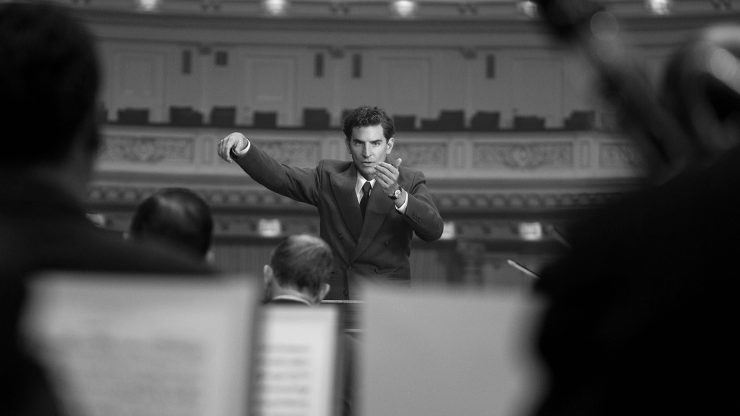
Maestro is a three-part snapshot. In gorgeous black and white we sweep ostentatiously about the 1950s. Bernstein (Cooper) is fizzing with energy, spring-boarded by a career-making opportunity to conduct the New York Philharmonic. He’s a player, a wit and a partier. It is in this capacity that he meets and woos actress Felicia Montealerge (Carey Mulligan). This first act, then, is the movie’s most romantic and magical, coupling these two together, setting them on a course toward the stars (those sensing a familiarity with A Star is Born are right to do so).
The midsection settles in the 1970s. Lenny and Felicia’s brood have grown and are given face by Maya Hawke as daughter Jamie. Here – and later – Felicia comes to the fore as her resentment and shame over Bernstein’s affairs and bisexuality have worn away at her domestic bliss. Cooper and Mulligan hit a different register together. They bristle and chide, and they’re just as effective. As with the first section, the aesthetics of the film shift to those of the times. ’70s fashions and the flavour of the New American Cinema inflect the picture (Mark Bridges is the costume designer here, telling you everything you need to know about Maestro‘s aspirations).
But if Bernstein’s affairs with men were an important part of his life and material to the structure and collapse of this film, Cooper seems ill-at-ease documenting them. Matt Bomer takes a frontline credit as Lenny’s ’50s fling, but you’ll be hard-pressed to catch his character’s name, and so it goes on. These men are given little-to-no screen time, let alone dimension. The one same-sex kiss is hidden from camera, middle-distance with Cooper’s back to us. This could be read as reflective of Bernstein’s disquiet with his own nature; indoctrinated shame from a society – and family – that don’t want to hear about it. But it also plays as reticent, or worse squeamish. And it furthers a wider sense of cliff-noting.
Cooper’s performance doesn’t help any with this. I remember reading Charles Bramesco’s review of comparable Oscar-bait biopic The Eyes of Tammy Faye from a year or two back and being struck by the wryness of his observation “That is certainly quite a lot of acting”. It’s not that Cooper is ‘bad’. I don’t think he is. But he is ‘big’. That’s fitting. If you’ve ever seen footage of Bernstein conducting or in interview, this is the man. But in tandem with the earnestness of the production – the inherent neediness of Maestro – it can feel like Cooper is constantly playing to camera, trying to second-guess which bit will be his nominee’s clip. Maestro sometimes feels like preening.
Mulligan is better. She’s shown herself one of our great modern players over and over, and her control and pitch here are marvellous. In a less competitive year she’d be a strong contender. Her poise and collectedness are thrown into sharp relief by Sarah Silverman, guest spotting as Lenny’s sister Shirley, all ticks and jitters in this opportunity to play it serious. In a sense she is fitting and Mulligan is the odd one out, as Maestro as a whole seems too distracted by how it looks rather than how it is.
How it is, alas, is poorly paced and pedestrian, in spite of Libatique’s best efforts to catch us off-guard. The frustrating sense that we’re rushing through things is only enhanced and contrasted by the third act, which beds down with and labours Felicia’s declining health, grinding the film to a halt for the tragedy of it all. It’s miserable, as it would have been, but after tilting at so many windmills, the intense focus on this time feels shrewd. Cooper once again collecting tearjerker moments for your consideration. The balance of the whole is thrown off. This is then underscored by a perfunctory coda of an elderly Bernstein sweating it up in a ’90s gay club, finally free of his matrimonial shackle, looking – quite unfortunately – like a predatory Jimmy Saville.
There is polish to Maestro. There is genuine affection, bordering on hagiography. Cooper has assembled a team of the best to ensure this thing looks, feels and sounds just right (even if that late-period make-up is as distracting as, well, Tammy Faye). But the whole is a jigsaw with pieces missing. It all just sort of arrives, and it all just sort of goes. It’s a movie that doesn’t feel like it’s been built with a beginning or end, so it just happens at you until it doesn’t, and the whole time Cooper wrestles for a tone to settle on. Flighty and more than a bit frustrating.

 The Lost Highway Hotel