
Year: 1974
Director: Guiseppe Patroni Griffi
Stars: Elizabeth Taylor, Mona Washbourne, Maxence Mailfort
This past month Todd Haynes’ ravishingly complex melodrama May December captured widespread acclaim with many reviews complimenting the film on its sense of wry camp, citing specific zooms, edits or line readings that accentuated this side of the picture. In an interview for Sight & Sound, Haynes expressed bemusement over this reaction to the film, which he views and presents sincerely. This dissonance between creator and audience got me thinking about camp; what we consider camp and the difference between accidental and intentional camp.
John Waters is often cited as a purveyor of camp, particularly in his riotous comedies that spotlight Divine; essays that deconstruct American middle-class values and hypocrisy, but do so with excess and panache that more than allows for Waters’ shaky technical ability (he would be the first to admit it). One of Waters’ favourite movies is Boom!, a melodramatic car crash of a film from Joseph Losey, starring the iconic Elizabeth Taylor. Posters for the movie pop up amid the garish décor in Waters’ films (it’s certainly there in Female Trouble). But while Waters may pivot to Losey’s late-’60s bomb, when I think of camp and Elizabeth Taylor, I’m drawn inexorably to the schizoid Identikit (aka The Driver’s Seat based on the novella of the same name by Murial Spark) from Guiseppe Patroni Griffi some years later.
By this time – and in a similar sense to Hollywood’s prior preeminent diva Joan Crawford – Taylor’s Hollywood star had lost some of its lustre. Gaudy box office failures like Boom! pointed the way to this inevitability, but they weren’t the whole story. Indeed, one might argue that this late period is Taylor’s most interesting, as she pivots (by choice or by happenstance) toward portraying women in various kinds of ill-health, struggling with addictions or mental instabilities.
It is in this fascinating portion of her career that Taylor found her way to Identikit, and a deliciously perverse psychological conundrum that manages to play as both camp and darkly affecting; the same line straddled (intentionally or not) by Haynes’ recent critical hit.
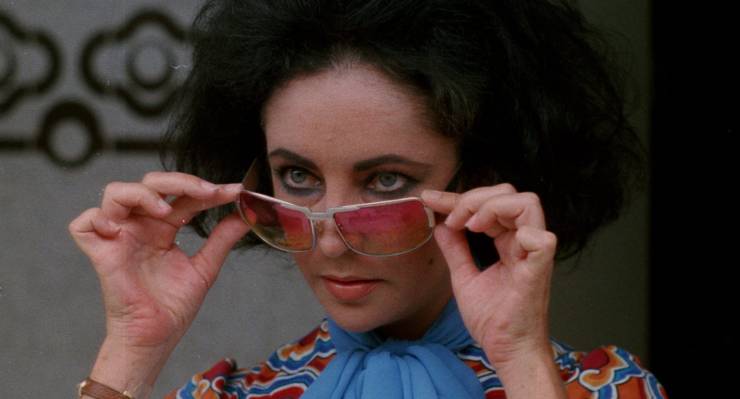
The film presents us Lise (Taylor), a fashion-conscious middle-class woman skirting middle age who leaves the comforts of her London home for Italy, seemingly on a whim, catching the attention of strangers with her striped, psychedelic outfits and diva-esque demeanor. Taylor herself – her fame and her baring – imprints a great deal of these associations on the character from the get-go. Decked out in a wondrously clashing and psychedelic outfit, Lise is desperate to stand out, desperate to be noticed, but moves through a grey world of airports and department stores that routinely fail to lavish her with the attention she wants.
Through this we are painted the picture of a Forgotten Woman, and Identikit begins unspooling its warped thesis on the psychological traps facing many middle-aged women, especially of a certain class, who have found themselves slipping into anonymity through dull domestic lives and western culture’s hungry obsession with youth. Lise is openly hostile to younger women in the film (chiding a shop girl she sees dancing as “stupid” is one such example). One bold shot sees her moving in the opposite direction to young women on an escalator. A visual idea. And perhaps Lise couples herself to an older woman – Mona Washbourne’s prattling tourist Mrs. Fiedke – in an effort to appear young by association.
Flat pronouncements from Lise (“This is a dead end”) scan as comical on first approach with the material. How are we to take her? But as the whole becomes clearer and the tragedy of Identikit asserts itself, Lise – and Taylor’s performance – take on a greater complexity. Like Lise’s outfit, Identikit starts off appearing garish and unseemly – something to laugh at – but beneath is a nest of tempestuous ideas. At its centre is a complex and ultimately sad individual enacting her own death wish.
It becomes clear as Lise’s journey progresses that she has no intention of returning. She leaves her passport in a taxi. She pays for drinks with large denominations and doesn’t care about change. This is her exit. Her blaze of glory. With astonishing black humour, she is denied the spotlight and control she yearns for every step of the way. Most chillingly, when she finally gets her wish and finds a man willing to kill her (Maxence Malifort) – at night in a park used chiefly as a cruising and cottaging spot – her one request (not to be raped beforehand) is denied her.
“Do you carry a revolver? … (Because) if you did you could shoot me” Lise tells another would-be rapist earlier in the film. This line could read as hysterical on the surface, but it is among the most overt proclamations of the woman’s intent on this trip, and its appearance following an attempted sexual assault is pertinent to what follows. Lise divorces her fetish to be killed from any sexual motive. She does not want to connect the two, even if a Freudian analysis might inevitably draw a sexual root motive, and there is something erotic at the heart of her desire for violence.
Lise talks boldly about her own orgasms earlier in the picture while interacting with another, comically buffoonish man, Bill (Ian Bannen). She’s frank about sex, but she also exudes the opinion that she is somehow over (as in above) or past sex. There is a reading here that Lise is asexual, her become asexual, or now considers herself as such. We see no evidence that she has had children or a present partner, and her approach to the subject throughout ranges from ambivalence to outright refusal. In turn, Identikit reflects a society that outright refuses her position. It could be seen as a comment on how asexuals are consistency denied their credibility.
Lise is hyper-specific about what she does want, however. She has considered her death, articulates clearly what she wants from it. She selects the method (stabbing), the murder weapon, even the moves required of her killer for her execution. That she won’t commit suicide – that her death must be in some sense a performance, a staging – only adheres to her frustration with being a Forgotten Woman. Her death is to be a statement of her life. Her corpse a monument. An art piece, even. Identikit is pitted with the a-chronological bafflement of the detectives clearing up her ‘mess’. Confusion and bemusement is all that she leaves behind. Its sadly heartbreaking, and allows the film at large to stand as a bold statement against the anonymity of society. This is a requiem for the individual, swallowed up in the homogeny of mid-20th century living.
And yes, it does feel camp. Lines like “You look like Red Riding Hood’s Grandmother. Do you want to eat me?” can’t help but feel extra, delivered sternly by Elizabeth Taylor garbed in a Technicolor dreamcoat. With her huge hair and outrageous outfits she even looks like Divine (complimentary), while Italian cinema’s then vogue for dubbing all performers lends itself to heightened vocal performances. Anyone familiar with Italian cinema from this period in all its guises will know the elevated tone I’m talking about here. It’s everywhere in Identikit.
But carried with this camp is something morbid, sordid, deeply sad and also deathly serious. This abuttal enhances the disparate sides of the film, accentuating both the dark and the darkly comic. Its a lot to take, and it feels as though the film hasn’t often been taken seriously in the past. Recently given new life through restoration, perhaps it will come to be reassessed. I hope so.
 The Lost Highway Hotel
1 thought on “Why I Love… #164: Identikit”