
Year: 2004
Director: Don Mancini
Stars: Jennifer Tilly, Redman, Billy Boyd
Don Mancini has a fairly unique pedigree in the gamut of popular horror franchises in that he has maintained a significant creative role for the entirety of the Child’s Play/Chucky series, writing all entries and directing three of them. He presently presides over the TV iteration, soon to return for it’s third season. One shoddy, non-canon studio reboot aside, Mancini has always been there, doggedly maintaining a wonky timeline (it even applies to the show, so do your homework beforehand!) of resurrections and metatextual impulses, steering his killer doll through various phases and incarnations.
For this viewer, the most fruitful and enjoyable entries are the Tiffany era which forefront the brassy comedic chops of Jennifer Tilly. 1998’s Bride of Chucky introduces Tiffany, the ex-girlfriend of fallen murderer Charles Lee Ray (Brad Dourif). By the end of that deliciously trashy entry (directed by Ronny Yu with a ’90s music video gun-metal sheen), Tiffany has suffered the same fate as her beau; trapped in the form of a children’s doll following some misadventures with voodoo. The flick ends on the uproarious reveal that Tiffany and Chucky have conceived some grizzling satanic spawn, paving the way for the pridefully tasteless and surprisingly inclusive Seed of Chucky.
The fifth film in the franchise embraces the meta comedy trappings of the mid ’90s horror resurgence popularised by Wes Craven’s New Nightmare and Scream (and arguably kickstarted as early as 1990 with Joe Dante’s Gremlins 2: The New Batch). Much in the style of New Nightmare and the Scream sequels, Seed of Chucky entwines Hollywood within the lore of the existing series, acknowledging its own success and folding it into the ongoing saga. So here Tilly does double duty; voicing the Tiffany doll but also playing a comically exaggerated version of herself, desperate to revitalise her career while shooting another Chucky sequel.
There’s always something enjoyable about watching a celebrity go to task with their own image and legacy, but the way Tilly leans into Mancini’s good natured character assassination here is a joy to behold. The version of her presented in Seed of Chucky leans into many assumptions about her character alluded to by the tabloid press; a slutty facsimile that’s more of a composite of some of her past film roles than an attempt to depict the person behind them. The role written and the performance given are, themselves, a comment on our perception of those in the limelight and our false assumptions of them.
The other significant presence here – and a clear indicator of Mancini’s influences and objectives when it comes to tone – is John Waters, who plays a tabloid photographer who ultimately comes a cropper midway through the film, doused in acid in his dark room. Waters’ cinema is iconic not only for its wantonly crass button-pushing (complimentary), but for its inclusion and celebration of queerness and counter-culture. Films like Pink Flamingos and Female Trouble have long legacies as Midnight Movie mainstays, and Waters’ friendship and multiple collaborations with drag star Divine created their own cinematic legacy.
Elsewhere, Seed of Chucky preempts the wider conversation happening currently about the abuse of power in the entertainment industry, as Tilly – desperate for a role in a religious epic being touted by Redman (himself) – prepares to prostitute herself in order to get the part. The casting couch is a long-held and mythologised aspect of the darker side of the movie business, and Seed is hardly the first film to address it. Its use here is twofold; to further exaggerate the version of Tilly being presented, but also to comment snidely on the sexually transactional aspect of Hollywood still very much in existence as we move into a new and supposedly reformed century. Seed sneers at the idea we have achieved equality, ultimately finding more liberalism in its antagonistic inhumane puppets.
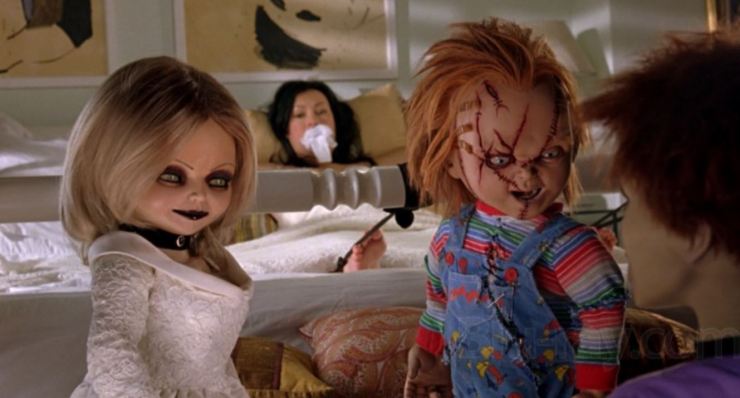
What’s most impressive and agreeable about Seed of Chucky is its treatment of its other central conceit; the titular offspring that we saw birthed at the end of Bride. Developing as its own concurrent tangent of the story, Chucky and Tiffany are reunited with the fruit of their plastic loins (voiced by Billy Boyd), and immediately the question of gender is proffered. Chucky – ever the misogynist – would prefer a son to carry on his legacy; Tiffany perceives their sexless child as a daughter. In a wry nod to Ed Wood, they tussle to name them either Glen or Glenda, and the film resolutely refuses to choose, accepting of a fluid, trans identity and appreciative of the anguish and struggle that comes from just such a sense of dysphoria, which Boyd conveys very well. Littered with bloody murders, cheap CG and lewd humour it may be, but Seed of Chucky is wonderfully ahead of its time in terms of representation. Not just of trans existence, but of trans emotions.
When Glen/Glenda approaches their parents to reveal their decision to live as both male and female, shifting identities as they desire, the parents are their typical sarcastic selves, but they’re not intolerant of the proposal, ultimately accepting Glen/Glenda’s approach to their gender. Tiffany, of course, is mildly ahead of Chucky, but only so as to spell out to the audience Mancini’s intention. For all their comically homicidal antics, Chucky and Tiffany are good role models for accepting and nurturing parents. An exchange in the second episode of the TV series stood out for many viewers and became something of a mandate for the franchise at large. Speaking to the TV show’s lead protagonist Jake (Zackary Arthur), Chucky offers up candidly, “I have a queer kid… gender fluid” “And you’re cool with it?” Jake responds, surprised, leading to the viral wry response, “I’m not a monster, Jake”. The legacy of that representation of progressive parenting – no matter how suspect the source – begins here in Seed of Chucky.
Mancini’s script is sharp throughout, riffing on pop culture at multiple opportunities (everything from Britney to The Shining), but in a manner that somehow hasn’t dated or particularly time-capsuled the film. Even his points of reference endure. This caustic sense of humour is mirrored in the approach to effects. Seed of Chucky is not a particularly high budgeted offering. It shows its limitations. But Mancini proceeds regardless, offering up a kind of crude digital slapstick that looked dated even at the time of the film’s release. Where inadvertently bad CG can fully hamstring a movie, Seed makes the crassness of these shots part of its endearing lunacy and sense of camp. It is complimented in the film’s bright palette. Tilly’s home looks like a Barbie dreamhouse (surely a knowing nod to, err, doll culture), while interiors echo the yellows and blues of the OG Good Guy box that the irrepressible Chucky arrived in. For a horror film – even a horror comedy – Seed of Chucky is unusually colourful; a visual simile for its relative queerness.
Come the end, Tiffany has possessed Jennifer Tilly – and this remains canon in the series for the next 20 years! – and has her own children, realising a (admittedly twisted) dream of surrogacy. It’s methods may be salacious, illegal and abusive, but Seed might also be called representative at some level of infertility struggles (Chucky and Tiffany impregnate Tilly against her will in the third act), perhaps viewable as a comment on the extreme lengths the unhinged might go to should the healthcare system fail them. That, ultimately, it is the system that has failed for its biases. Granted, Seed of Chucky presents an extreme and ludicrous scenario, and this reading and representation is far from ideal, but it does acknowledge the desperation entailed in creating a family outside of the bounds of conservative norms. Let me stress, I am not an advocate for Chucky and Tiffany’s mad behaviour!
So there’s more happening in Seed of Chucky than one might not expect of a) a pop-horror slasher franchise about killer dolls or b) the fifth iteration of said series, but Seed is no sermon. Its a taut, tight blast of crude and gleefully offensive material. It’s a movie where John Waters snaps photos of the shadow of a puppet that’s masturbating over an issue of Fangoria. A movie with a garish CG title sequence of sperms swimming to penetrate an egg inside a plastic doll. A movie (rightfully) in the thrall of the Wachowski’s Bound (another trans connection? deliberate?). Seed of Chucky is a fucking hoot, right up there with Bride of in the centre of a series showing itself in rude health, regardless of budgetary constraints. An anarchic, progressive joy.
 The Lost Highway Hotel