

Director: Greta Gerwig
Stars: Ryan Gosling, Margot Robbie, Hari Nef
“How long have we been waiting for this?” asked the excited young woman next to me of her friend at the Barbie screening I attended while we all waited in the dark to see what Greta Gerwig had in store for us.
A sold out screening. Nearly everyone in pink. She sounded so happy, so giddy. Her eagerness might well send a withering shiver down the spine for those of us deeply wary of hollow corporate fodder. Every ensuing generation seems more and more susceptible to the brainwashing machine of consumer culture. Barbie is a significant totem of this epidemic. But much as we prattle and grouse about it, we kowtow just the same. Hell, I was there in a ‘Barbenheimer’ t-shirt. I’d paid my dues already.
Barbie may be a hypersexualised plastic doll promoting these same consumerist values but – to generations raised in its ecosystem – its also a lifestyle aesthetic, it’s aspirational, it’s a mirror to days past. It is, in short, a meaningful cultural touchstone. Meaningful. Something to be excited about. An emotional connection, one that can be malleated to suit the consumer. Adaptable to gender. Sexuality. Something that can be repurposed or wielded to the needs of the participant. Something powerful.
You can scoff at Mattel producing a movie for their product, but you probably couldn’t ask for a better outcome. That’s thanks to Greta Gerwig, a woman whose extant body of work already glows. In movies like Frances Ha and Mistress America she transmitted truisms about our contemporary world via charming comedic performance. Behind the camera she has furthered this exchange with universally-recognised growing pangs (Lady Bird) and by sharing her own connection to a nostalgic literary touchstone (Little Women). In fact, the leap from Little Women to Barbie is not so far. Gerwig is selecting these things from our bookshelves and the boxes under our beds and using them as a gateway to new interpretations and ideas. New ways to feel seen.
:max_bytes(150000):strip_icc():focal(999x0:1001x2)/Barbie-movie-040423-04-2000-e5c95c3f84b64a078d08a5a8f1a217c4.jpg)
A hundred and one influences swirl in and around Barbie from the get-go. The glorious intro riffs spectacularly on 2001: A Space Odyssey. When we meet Stereotypical Barbie (career-best Margot Robbie) in Barbieland, she sails down from her dreamhouse, gliding through air like Mary Poppins, her dress billowing like Marilyn’s in The Seven Year Itch. Within seconds we’re shown Gerwig’s elaborate pastel set, with see-through homes that recall the grand theatrical designs of The Ladies Man or Godard and Gorin’s Tout Va Bien. Gerwig has already shared publicly her ‘mood board’ of film references for Barbie, reaffirming her cineaste pedigree, but the way the film uses them feels akin to The Simpsons at its fervent ’90s best. The nods and references are part of the text, not Easter eggs for collection. Art and media assimilated into visual language.
Barbieland is a place born of our collective imagination spurred by the stylings of Mattel. The world in our minds eye where Barbies live and play. Where the inanimate comes to life. But for Stereotypical Barbie, all is not as it ought to be. Suddenly, thoughts of death are interrupting her fabulous dance routines and on the back of this further troubling malfunctions arise. Visiting Weird Barbie (Kate McKinnon), she is offered but one solution (one solution); journey to the Real World and find the girl who’s upset the psychic link between them.
This sounds like a familiar roadmap for a tie-in movie. Go a bit meta. Lace with jokes. Make a good time of it. Worked for The LEGO Movie. This is what the marketing for Barbie has established. But Gerwig’s movie goes further than that. It’s a lot weirder than that. It’s knotty, existential, angry, terrified and fatigued. And who wouldn’t wonder, since it’s often about Being A Woman as much as it is about Being A Girl. The candy-coloured hues may make this look like a kids’ movie through their associations, but Gerwig has fashioned from them an exasperated menstrual roar, one that pithily takes down every little dweeb out there who’ll noisily rally against it.
Barbie goes to the Real World (itself a heightened Tati-esque version of reality) and finds the mother and daughter (America Ferrera & Ariana Greenblatt) who have been inadvertently causing her upset, but swooning himbo Ken (Ryan Gosling) has made the journey with her. Discovering that the Real World is a patriarchal mirror to the harmonious matriarchy of Barbieland, he goes full incel. Returning ahead of her, Ken brings noxious notions to Barbieland, creating far greater problems for Stereotypical Barbie to iron out.
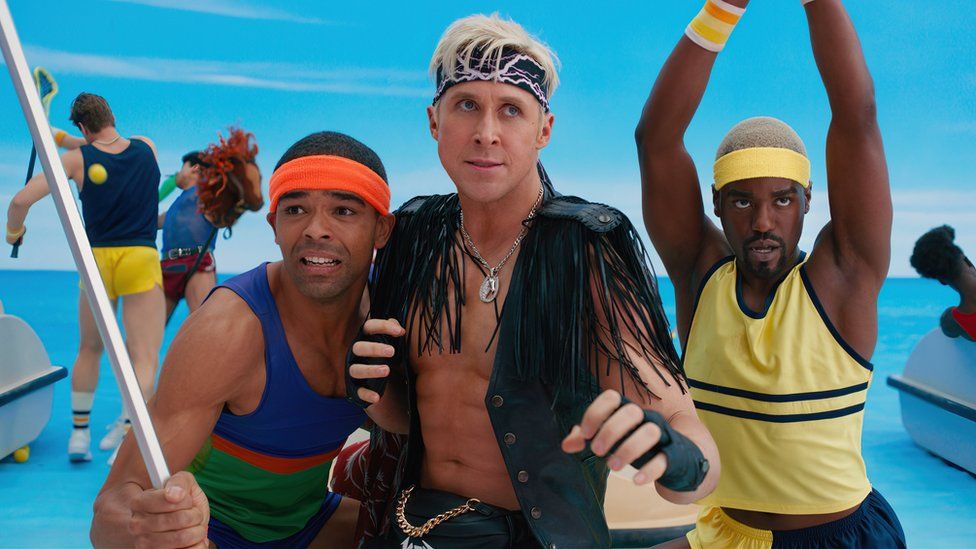
This is all conveyed via witty lines, hilariously silly sight gags, to-die-for production design and gloriously physical comedic performances. Will Ferrell is back to his stupid best as the confused CEO of Mattel’s wryly all-male board. Gosling eats up everything he’s given to project pure Kenergy™, and comes breathlessly close to taking over the entire movie in the process. Cera is absurdly brilliant as the lone, frustrated Allan. Gerwig ransacked the cast of Sex Education for this thing, and everyone brings it. And it’s all in service of a well-articulated outpouring of anxieties and observations from Gerwig.
Through the transparent cellophane packaging of the movie screen, she unboxes expectations of perfection that can only deteriorate or lead to a sense of self-loathing. She openly criticises the unobtainable ideals imposed on society by Mattel. She engages fully in the complex legacy of the product. And, more positively, investigates the emotional connectivity we make with formative toys; the very thing that’s brought us to see the movie in the first place. Barbie even seems to anticipate its own backlash from grumpy sexless keyboard warriors and addresses them within the text. It’s a surprisingly thorny, considered piece of work. You might well dismiss much of it as Feminism 101, but the amount of time and effort put into this thing is self-evident. Barbie is as ambitious as it is impressive.
Busy as the piece is emulating the busy mind, it is also – thank god – an absolute riot. And for all the stresses, there’s optimism here, too. Gerwig sees it in Ken’s ultimate inability to rest on the laurels of his (perceived) gender. She hopes for a brighter future, even while reckoning on a fight to get there. She’s gotten away with something that’s both admirably weird – Robert Altman’s Popeye weird – and yet totally accessible. Accessible because she’s directed so much attention to her audience. It also helps that this thing absolutely sprints along.
Even the seed of hollow consumerist greed that birthed Barbie into our cinemas is lambasted throughout. In a manner collected and repurposed beautifully from seminal cinematic landmark Josie and the Pussycats, Gerwig places product placement so glaringly within frame as to satirise ungainly corporate greed. This movie shares that movie’s undying appreciation of the tacky, the gaudy and the blissfully silly. With all that weird piled on top, that makes it a kissing cousin of Romy and Michele’s High School Reunion, too. And there are few compliments as great as that.
Gerwig’s Barbie will be degraded, sequelised, etc. Overuse will inevitably tarnish. The sheen will fade. But for now – right now – things are, simply, “Sublime!”.
And I don’t need to wonder if the young woman sitting next to me had her expectations met. I know she fucking did.

 The Lost Highway Hotel
8 thoughts on “Review: Barbie”