

Director: Ridley Scott
Stars: Susan Sarandon, Geena Davis, Harvey Keitel
Thelma & Louise came at an important time for its director, Ridley Scott, who had burst onto the scene with soon-to-be sci-fi favourites Alien and Blade Runner, but whose career had started to look shaky come the late ’80s. Commercial and critical failures like Legend and Someone to Watch Over Me lessened his collateral, just as younger brother Tony was achieving significant box office hits with Top Gun, Beverly Hills Cop II and Days of Thunder. Ridley may have appeared to be the visionary aestheticist, but baby bro’s testosterone-pumped style was pulling in the punters.
Viewed through this lens, one is tempted to look upon Thelma & Louise as a challenge to all that machismo. It otherwise seems like an odd fit for Ridley on the surface, but he’s since proven out as a career chameleon. He talks of his own nous and prowess with the kind of arrogance that makes him easy to dislike. That dogged work ethic also means that hits come as often as misses, but when the mixture is right, he’s among the best out there.
It sometimes takes an outsider’s perspective to create an iconic vision of America. I’m thinking of Wim Wenders with Paris, Texas or Andrea Arnold with American Honey. Thelma & Louise is a bedfellow to these titles. A road movie and an evocation of such a broad and sweeping nation at a particular time. The movie’s script may have originated in the country’s heartland – Callie Khouri was raised in Texas and Kentucky – but one might argue that her sense of rousing Southern comfort is tempered by Scott’s alienation. That in between their knotted fingers the magic of Thelma & Louise is formed.
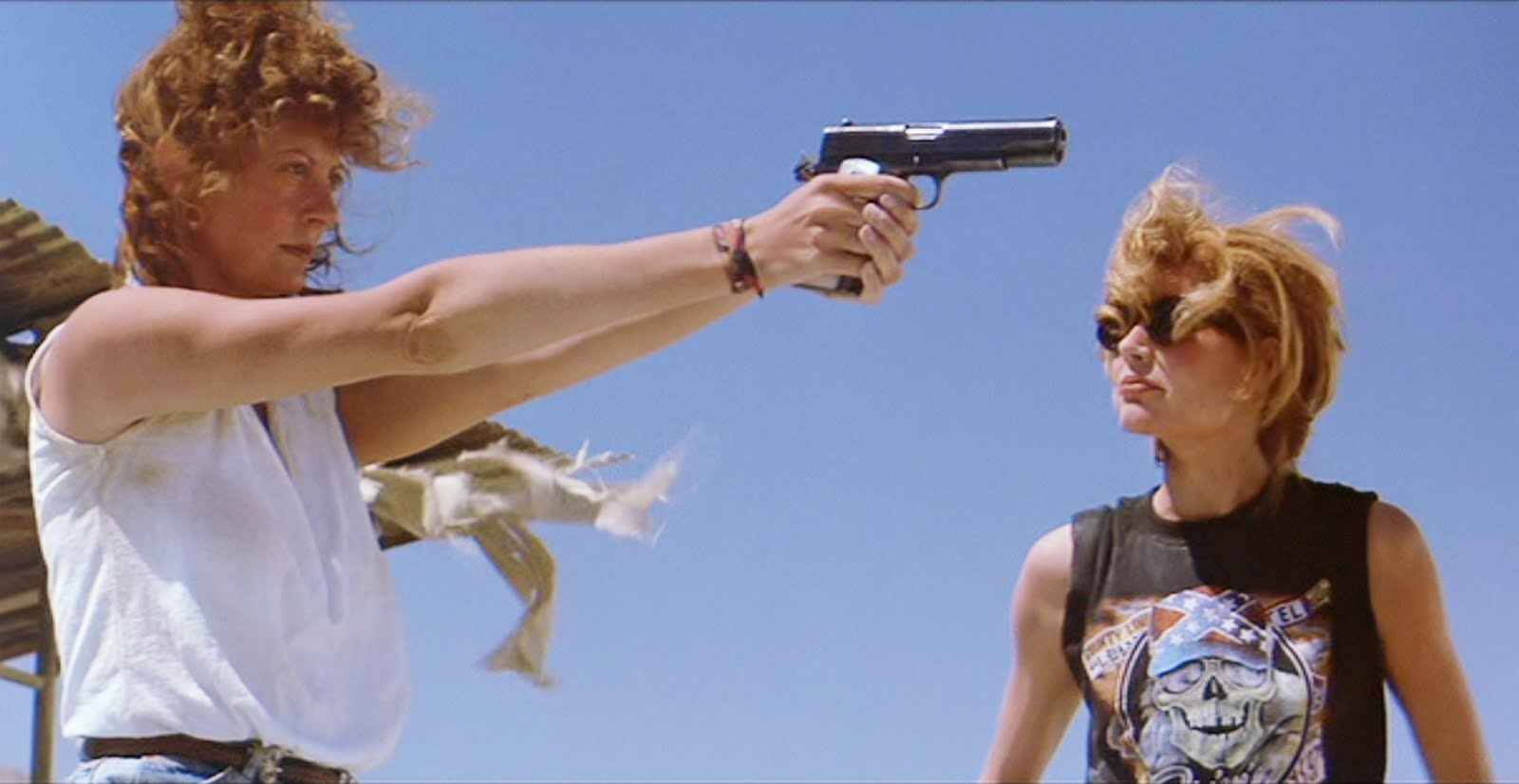
Khouri certainly eviscerates the country’s oppressive patriarchy at every conceivable turn. Bolting from their dissatisfying lives in Arkansas, Thelma (Geena Davis) and Louise (Susan Sarandon) are unlikely friends skipping town for the weekend who run into trouble at a roadside bar. Louise shoots and kills would-be rapist Harlan (Timothy Carhart) in the venue’s parking lot and the two women impulsively take to the road; fleeing their staid old lives and chasing after the mythos of the American outlaw.
Everywhere one looks the male sex is found wanting. Thelma’s heel of a husband Darryl (Christopher McDonald) is a laughable man-child incapable of satisfying her in the bedroom. The film is littered with leering louts or opportunist attackers. Even Brad Pitt’s sensationally objectified tall-drink-of-water JD countermands his usefulness as an outlet for Thelma’s sexual gratification by robbing the women first chance he gets. Their one male advocate and apologist happens to be their chief pursuer; ineffectual lawman Hal (Harvey Keitel). From state troopers to truckers, there’s not a useful fella among them. How fucking refreshing this must have felt in the climate of 1991’s machismo fuelled populist cinema. How overdue.
It’s not just the failings of men that the film addresses, but a dissatisfaction and malaise with authority in general; a healthy streak of distrust. Consider the glee, for instance, in a late scene when a mountain biking Black man (Noel L. Walcott III) happens upon a state trooper’s seemingly abandoned vehicle in the New Mexico wilds. We know that the officer (Jason Beghe) is trapped in the trunk of the car, but our marijuana smoking cyclist isn’t about to come to his aid.
This scene compliments the women’s rejection of domesticated suburbia and the dying materialism of the Reagan/Bush administrations that dominated the 1980s. Thelma & Louise has punk rebel spirit. It can get a little broad and goofy in expressing it (the detonation of a trucker’s big-rig is worth cheering, but it’s a little cartoonish), but Khouri’s script is natty and articulate when it comes to addressing the country’s ills as experienced by women under the thumb of the patriarchy and its rule of law.
Thelma and Louise reject it and instead choose to pursue a fantasy of emancipation. Their chosen destination is Mexico, but really they’re escaping into one of America’s great myths, that of the lawless fugitive. Racing after the legacies of the likes of Jesse James or Bonnie and Clyde, Thelma and Louise manifest their own legend. They self-actualise. Thelma takes the prideful boasts of JD and uses them verbatim when holding up a convenience store, feminising a traditionally male outlaw role.
The queering of gender norms manifests in other ways on their journey. The farther from civilisation they go, the more rough-hewn the two women become. By the third act the two of them look like cowboys. Hats. Denim. Long pants. While Thelma & Louise is one of the great films about a female friendship, it’s savvy enough to acknowledge its own latent homosexual undertones, and the bond between the women brokers the physical right before their fateful last drive. They have finally transcended the need for men altogether. The world not ready for them, they exit. Perhaps they’ll return, phoenix like, when it is.
Scott’s delivery of all of this borrows freely from his baby brother’s playbook at times. Thelma & Louise has occasional stints of bombast, but this is also keenly a landscape picture. The film’s opening prefigures its ending with a context-free pan across a Fordian Nevada desert scene, while the film’s transitional sequences highlight the wide, open and diverse topography of the women’s journey. But Thelma & Louise also evidences a romanticism for the waystations of our human imprint on the land. The motels, diners and gas stations. The roar of traffic is a constant. The kicked-up dust. There’s a strangely beautiful undercurrent to the movie that adores these mezzanine places and recognises their own lonesome poetry.
Davis and Sarandon are great of course. Icons both. But the unseen MVP in all of this might be Hans Zimmer, who offers up one of his most surprising and giving scores, one that seems keen to tap into Ry Cooder’s work on the aforementioned Paris, Texas. Zimmer finds a key of yearning contemporaneous to our heroines. Completing the set, Adrian Biddle shoots the picture with a billowing sense of wonder for these women and this setting. There’s something sensuous about it, uncontainable, caught most keenly in the whirls of dust and smoke that roil at the film’s finale.
Khouri’s script is ultimately the catalysing fulcrum for all of these outer qualities. It is desirous fantasy that speaks to at-least half its audience from a place within. Deep in the bones and in the blood. I can only praise Scott’s deference to Khouri here. He animates her female gaze without ego. He acknowledges and codifies its honesty.
I had underestimated this picture and its retained power. I thought it might feel kitsch, but it doesn’t. In another summer of been-there, done-that superhero pictures and other IP resurrections, this might just be your best chance of escape.
Hit the road again.
 The Lost Highway Hotel